Carrier-Grade Voice Mail System
A reliable, scalable Voice Mail System that ensures no call goes unanswered — recording messages when subscribers are busy or unreachable, delivering notifications via MWI and SMS, and providing multi-access retrieval through phone, web, and email.
The universal safety net for every missed call — recording, storing, and delivering messages across phone, web, and email
Every Unanswered Call Is a Lost Connection
When a subscriber is busy, out of coverage, or simply cannot answer — without voicemail, that call disappears forever. VMS has been the telecommunications safety net for decades.
Missed Calls Mean Missed Business
In business, an unanswered call is a lost opportunity — a missed sale, an unconfirmed appointment, an unresolved support issue. Without voicemail, callers hear endless ringing and hang up. With voicemail, they leave a message and expect a callback. One leads to lost revenue; the other to retained customers.
Subscribers Expect Voicemail as Table Stakes
Voicemail is not a premium feature. It is basic telephony infrastructure that every subscriber expects — like dial tone. Operators who fail to provide reliable, accessible voicemail see higher churn and lower customer satisfaction scores.
Fragmented Message Access Frustrates Users
Traditional voicemail forces subscribers to dial in, navigate audio menus, and listen to messages sequentially. Modern users expect to see their messages — read transcripts, play specific messages, delete with a tap — from their phone, tablet, or computer. Audio-only access is no longer sufficient.
Storage and Retention Compliance
Regulated industries — finance, healthcare, legal — require message retention for compliance and dispute resolution. Without a carrier-grade VMS with configurable retention policies, secure storage, and audit trails, operators expose themselves and their enterprise customers to regulatory risk.
The Voicemail Architecture — Simple, Reliable, Proven
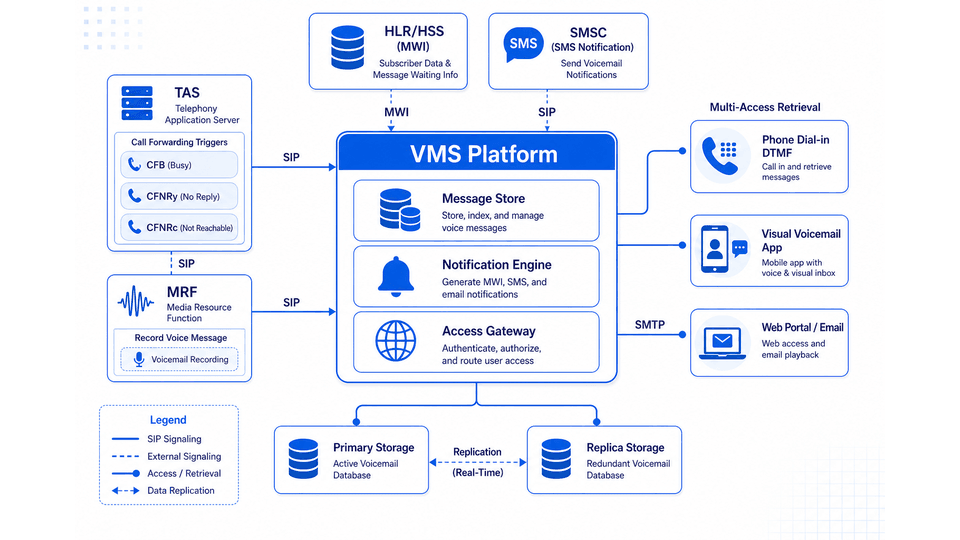
ZBensoft VMS plugs into the existing telecom network and works with every phone, every network generation, and every access method
Message Recording & Storage
When TAS routes an unanswered call to voicemail, the MRF plays the greeting and records the message. The audio file is stored on redundant storage with automatic replication. Messages are retained according to configurable policies — days, weeks, or years depending on regulatory requirements.
MWI & SMS Notification
The moment a message is recorded, VMS triggers a Message Waiting Indicator on the subscriber's phone — the familiar voicemail icon or stutter dial tone. For smartphone users, an SMS or push notification delivers the caller ID and message duration, enabling one-tap access.
Multi-Access Retrieval
Subscribers retrieve messages through any channel: dial-in access with DTMF playback controls, visual voicemail on smartphone apps and web portals, or voicemail-to-email with audio file attachments. Every access method shows the same inbox — read/unread status syncs across all channels.
Operator Management & Analytics
Operations teams manage subscriber voicemail boxes through a centralized portal — provisioning, depersonalization, storage quotas, greeting management. Built-in analytics track mailbox utilization, peak recording hours, and storage trends for capacity planning.
Features That Make Voicemail Work for Everyone
Not every subscriber needs every feature. ZBensoft VMS supports the full spectrum — from basic audio-only to full visual voicemail with transcription.
Message Waiting Indicator
The universal voicemail signal — a notification icon, stutter dial tone, or SMS alert that tells subscribers they have unheard messages. Works on every phone from 2G feature phones to 5G smartphones.
Visual Voicemail
A smartphone app and web interface that displays messages as an inbox. Subscribers see caller ID, timestamp, and duration — play, delete, save, or call back with a tap. No dial-in, no menus, no waiting.
Voicemail-to-Email
Every new voicemail automatically forwarded as an email with the audio file attached as .mp3 or .wav. For business users who live in email, this eliminates the separate voicemail workflow entirely.
Multi-Language Greetings
Subscribers record personal greetings in their preferred language. System prompts are available in 30+ languages. Operators configure the default language per subscriber group — essential for multi-lingual markets and international roaming.
Message Transcription
Optional ASR-based voicemail-to-text. Subscribers read a transcript when they cannot listen — in a meeting, in a noisy environment, or when the message is in a non-native language. Transcripts are searchable and forwardable.
Auto-Attendant & Call Routing
Configurable greeting and routing rules per mailbox. Business subscribers set different greetings for business hours, after hours, and holidays. Calls can be routed to different mailboxes or forwarded to live attendants based on caller input.
Voicemail by the Numbers
A service every subscriber expects. Here is what a properly deployed carrier-grade VMS delivers.
Redundant storage with automatic replication across data centers. No message is ever lost due to hardware failure. Geo-redundant deployment ensures messages recorded in one city are accessible from another within seconds.
System prompts available in all major world languages and regional dialects. Operators configure default languages per subscriber segment — essential for serving diverse markets across Asia, Africa, Europe, and the Americas.
Works on every phone ever manufactured. 2G feature phones get MWI + dial-in access. Smartphones get visual voicemail apps and push notifications. Business users get email delivery and web portals. One VMS serves every subscriber segment.
When a subscriber is on a call, out of coverage, or has their phone switched off — VMS captures every attempt. CFB, CFNRy, and CFNRc triggers ensure 100% coverage of all unreachable scenarios.
How a Voicemail Message Gets From Caller to Subscriber
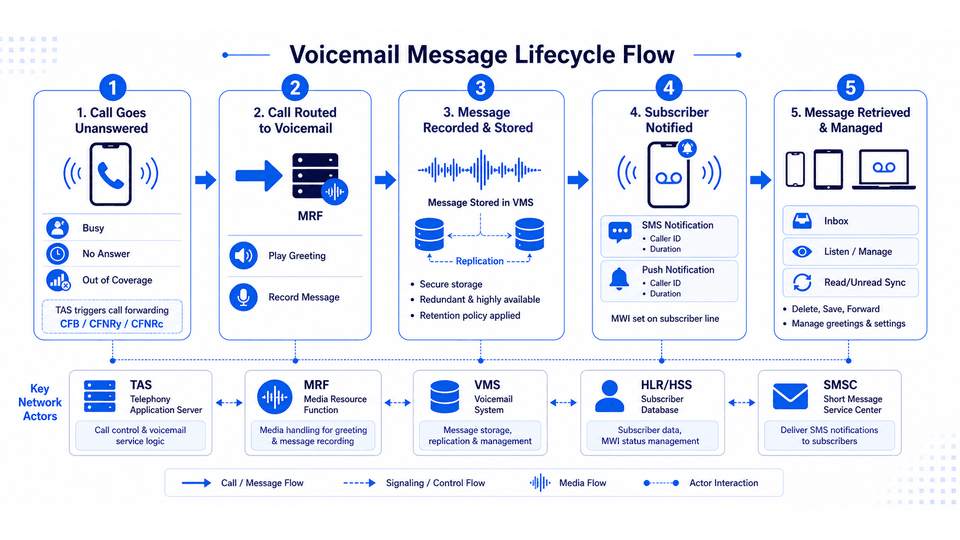
The classic voicemail flow — simple, reliable, and completed billions of times every day worldwide
Call Goes Unanswered
The caller dials the subscriber. The subscriber is busy, out of coverage, or does not answer within the configured ring timeout. TAS detects the unreachable state and triggers the appropriate Call Forwarding rule — CFB, CFNRy, or CFNRc.
Call Routed to Voicemail
TAS forwards the session to VMS via the MRF. The MRF plays the subscriber's personal greeting and begins recording. The caller hears a beep and starts speaking.
Message Recorded & Stored
The MRF captures the caller's audio, encodes it to the configured format (AMR, G.711, MP3), and delivers the file to VMS storage. The message is saved with metadata — caller ID, timestamp, duration — and replicated to redundant storage immediately.
Subscriber Notified
VMS triggers an MWI notification to the HLR/HSS, which lights up the voicemail icon on the subscriber's phone. Simultaneously, an SMS or push notification is sent with caller ID and duration. The subscriber sees "1 New Voicemail" on their screen.
Message Retrieved & Managed
The subscriber retrieves the message through their preferred channel — dial-in, visual voicemail app, web portal, or email attachment. After listening, they save, delete, or forward the message. All actions sync across every access channel in real time.
Who Depends on Carrier-Grade Voicemail
Every mobile operator, fixed-line carrier, and enterprise UC platform on the planet provides voicemail. Here is who trusts ZBensoft VMS.
Mobile Network Operators
Provide basic voicemail to millions of prepaid and postpaid subscribers as a core network service. VMS integrates with TAS, MRF, HLR/HSS, and SMSC for MWI and SMS notifications — a turnkey voicemail solution for 2G through 5G networks.
Fixed-Line & Cable Operators
Voicemail for residential and business phone lines over PSTN and VoIP. VMS supports both traditional dial-in access and modern web/email retrieval — bridging legacy and IP telephony for fixed-line subscribers.
Enterprise UC & Cloud PBX Providers
Business-grade voicemail with auto-attendant, departmental mailboxes, message forwarding, and compliance archiving. VMS integrates with IP-PBX and unified communications platforms to provide voicemail as part of the enterprise communication suite.
MVNOs & Service Providers
Launch branded voicemail services without building voice infrastructure. VMS-as-a-Service with multi-tenant isolation — each MVNO gets dedicated mailboxes, greetings, and branding while sharing the underlying platform infrastructure.
Frequently Asked Questions
How does VMS integrate with the existing mobile network?
ZBensoft VMS integrates with TAS (for call forwarding triggers and MWI signaling), MRF (for greeting playback and message recording), HLR/HSS (for MWI activation), and SMSC (for SMS notifications). These are standard 3GPP interfaces — no proprietary protocols. VMS works with any 3GPP-compliant TAS, MRF, and HSS from any vendor, making it deployable alongside existing network infrastructure without a full core replacement.
What storage capacity does VMS require for a typical operator deployment?
Storage requirements depend on subscriber count, average messages per subscriber, and retention policy. A mid-size operator with 5 million subscribers, averaging 3 stored messages of 30 seconds each, requires approximately 8-12 TB of redundant storage. ZBensoft VMS supports both NAS/SAN storage for on-premise deployments and cloud object storage (AWS S3, Azure Blob) for hybrid and cloud-native deployments. Storage scales independently of the application layer.
Can subscribers access voicemail from multiple devices simultaneously?
Yes. ZBensoft VMS maintains a unified message state across all access channels. A subscriber can listen to a message on their phone, see it marked as read on their web portal, and forward it from their email — all within seconds. Message state synchronization is real-time, powered by the VMS message store's pub/sub notification system that pushes state changes to all connected access channels immediately.
Full-Stack Technology for Your Telecom Business
ZBensoft integrates charging, core network, and AI capabilities to help operators run efficiently and grow sustainably.
Request a Demo