Intelligent Voice Service Orchestration for IMS Networks
A carrier-grade Telephony Application Server that delivers the complete MMTel supplementary service suite — from basic call forwarding to advanced multi-party conferencing — across VoLTE, VoWiFi, VoNR, and fixed-line networks, enabling operators to retire legacy circuit-switched voice infrastructure while launching new programmable voice services.
Call service logic engine — from basic calling to immersive voice experiences
Legacy Voice Infrastructure Is Costing You Millions
Circuit-switched voice networks were built for a different era. Modern operators need IP-based service agility, not hardware dependencies.
CS Network Maintenance Costs
Maintaining parallel CS and IMS networks doubles OpEx. Legacy MSC hardware consumes power, space, and specialized engineering talent — costs that persist even as voice traffic shifts to VoLTE.
Months to Launch New Services
Adding a new supplementary service like call screening or location-based forwarding in legacy CS requires vendor-specific hardware upgrades and months of integration testing. The market doesn't wait.
No 5G Voice Path
5G Standalone has no circuit-switched fallback. Without a modern TAS, operators cannot offer basic voice on 5G SA — blocking the entire 5G monetization roadmap. Every SA subscriber needs IMS voice.
VoWiFi & Fixed Access Gaps
Legacy CS voice is mobile-only. Modern subscribers expect seamless voice across WiFi, fixed broadband, and mobile — with the same service profile and feature set on every access network.
TAS at the Heart of IMS Voice
The Telephony Application Server sits between the S-CSCF and the subscriber's service profile, executing call logic for every voice session
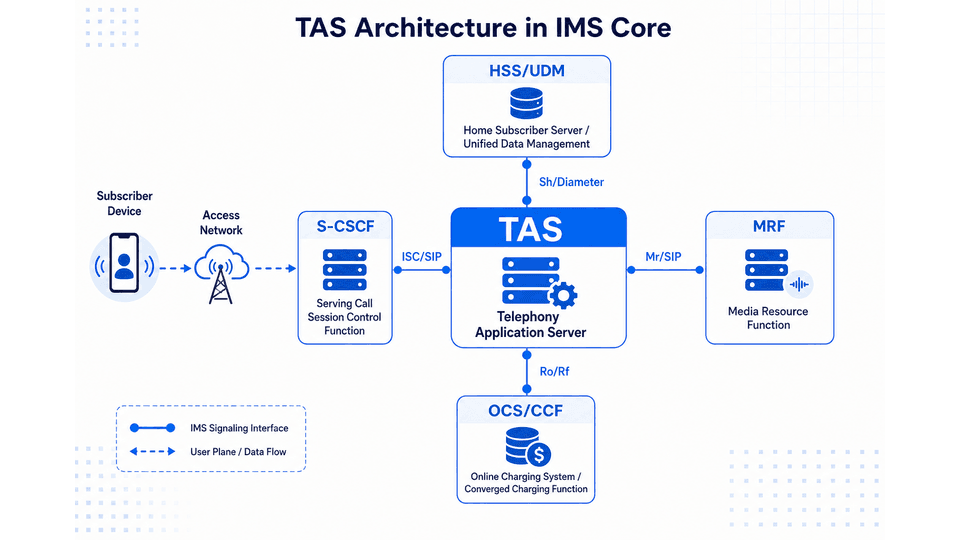
Service invocation interface between S-CSCF and TAS. The S-CSCF forwards SIP sessions to TAS based on initial Filter Criteria (iFC) from the HSS, triggering the appropriate supplementary service logic.
Subscriber profile and service data repository interface. TAS retrieves service-specific subscriber data — forwarding numbers, barring lists, conference preferences — directly from the HSS/UDM.
SIP interconnect with other IMS Application Servers and CSCFs. TAS acts as a Back-to-Back User Agent (B2BUA), terminating originating SIP dialogs and initiating new ones toward destination endpoints.
Online and offline charging interfaces to OCS/CCF. TAS reports service usage events (call duration, conferencing, call forwarding) in real time for accurate billing and revenue assurance.
Complete MMTel Supplementary Service Suite
Every telephony feature subscribers expect — delivered natively over IP with cloud-scale reliability
Caller ID & Privacy
Calling Line Identification Presentation (CLIP) and Restriction (CLIR). Subscribers control who sees their number with per-call and permanent privacy settings.
Call Forwarding
Communication Forwarding services (CFU, CFB, CFNRy, CFNRc). Intelligent routing based on subscriber state — unconditional, busy, no-answer, not-reachable.
Call Barring & Screening
Incoming and outgoing call barring (OCB/ICB), anonymous call rejection (ACR), and user-defined screening lists. Enterprise-grade control over voice access.
Multi-Party Conferencing
Three-way calling (3PTY) and ad-hoc conference bridging. TAS coordinates MRF resources to blend multiple voice streams into a unified conference experience.
Call Waiting & Hold
Call Waiting (CW) and Call Hold (HOLD) with network-initiated reconnection. Subscribers never miss important calls — switch between active and held sessions instantly.
Voicemail Integration
Communication Diversion to voicemail with Message Waiting Indication (MWI). TAS routes unanswered calls to the VMS platform and notifies subscribers of pending messages.
Measurable Business Impact
A modern TAS transforms voice from a cost center into a programmable revenue platform
Retire legacy MSC hardware, consolidate operations onto a single cloud-native voice platform, and eliminate parallel network maintenance costs.
Enable Voice over New Radio for 5G SA subscribers. Every 5G standalone deployment requires IMS voice — TAS is the application layer that makes it work.
DevOps-enabled service creation. New supplementary services can be developed, tested, and deployed in weeks — not the months that legacy CS platforms require.
Geo-redundant active-active deployment ensures voice service continuity. SR-VCC guarantees seamless handover to 2G/3G when 4G/5G coverage drops.
How TAS Processes Every Call
From SIP INVITE to session teardown — TAS executes service logic in milliseconds for every voice call
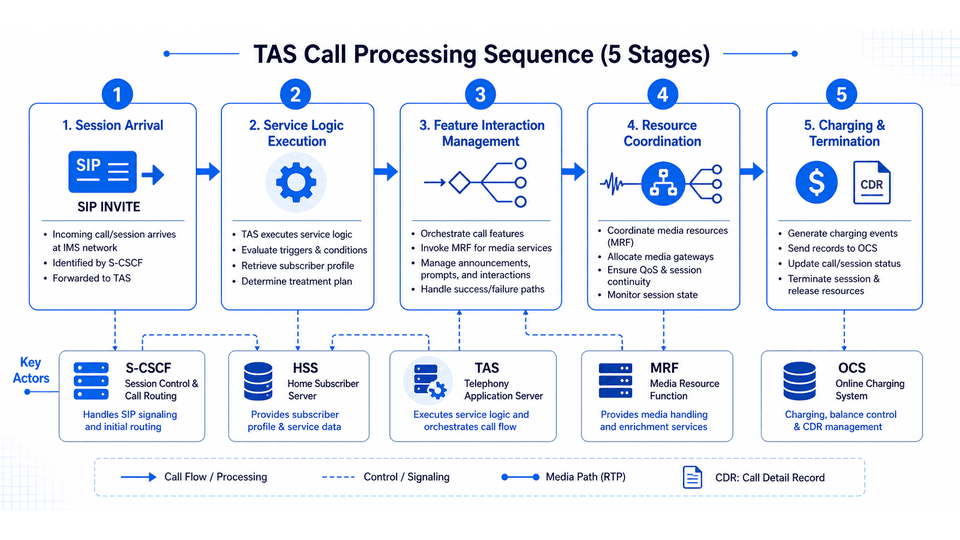
Session Arrival
S-CSCF receives a SIP INVITE and evaluates Initial Filter Criteria (iFC) from the HSS. If the subscriber has active supplementary services, the session is forwarded to TAS via the ISC interface.
Service Logic Execution
TAS acts as a B2BUA, terminating the incoming SIP dialog and applying the subscriber's service profile. Call forwarding, barring checks, caller ID rules, and routing preferences are evaluated in sequence.
Feature Interaction Management
Multiple supplementary services often interact — e.g., Call Forwarding + Call Barring + Voicemail. TAS resolves conflicts using 3GPP-defined feature interaction rules to ensure predictable behavior.
Resource Coordination
When the call requires media resources (conference bridge, announcement, transcoding), TAS signals the Media Resource Function (MRF) and coordinates SIP re-INVITEs to connect the subscriber to media endpoints.
Charging & Termination
TAS reports service usage to OCS/CCF via Ro/Rf for real-time credit control. When either party hangs up, TAS processes SIP BYE, generates final CDRs, and releases all session resources.
Who Needs a Modern TAS
Any operator delivering voice services over IP — from national MNOs to enterprise UC providers
Mobile Network Operators
Launch VoLTE and VoNR for 4G/5G subscribers. Retire legacy CS infrastructure, reduce OpEx, and deliver HD voice with the full supplementary services subscribers expect.
MVNOs & Light Operators
Launch branded voice services without building your own IMS. TAS-as-a-Service enables agile MVNOs to offer enterprise-grade telephony features from day one.
Fixed-Line & Broadband Operators
Extend voice services over fiber and broadband with VoWiFi and fixed IMS access. One service profile works across mobile and home — true fixed-mobile convergence.
Enterprise UC & Cloud PBX Providers
Power your unified communications platform with carrier-grade call control. TAS provides the SIP B2BUA engine behind cloud PBX, hunt groups, auto-attendant, and enterprise voice.
Frequently Asked Questions
How does TAS differ from a traditional Class 5 softswitch?
TAS is an IMS-native Application Server that operates on SIP and 3GPP IMS interfaces (ISC, Sh, Mw), whereas Class 5 softswitches typically use legacy protocols or proprietary SIP extensions. TAS is designed for the IMS architecture with native HSS/UDM integration, iFC-based service triggering, and B2BUA architecture — enabling it to serve VoLTE, VoWiFi, VoNR, and fixed access from a single platform.
Can ZBensoft TAS work with an existing IMS Core from another vendor?
Yes. ZBensoft TAS implements standard 3GPP ISC (SIP), Sh (Diameter), and Ro/Rf interfaces, making it interoperable with any 3GPP-compliant S-CSCF, HSS, and OCS — regardless of vendor. Operators can modernize the application layer without replacing the entire IMS Core.
What supplementary services are supported out of the box?
ZBensoft TAS supports the complete 3GPP MMTel service set: CLIP/CLIR, CFU/CFB/CFNRy/CFNRc, CW, HOLD, 3PTY conferencing, OCB/ICB, ACR, MWI, and voicemail integration. Additional services can be developed through the programmable service execution environment using standard Java or REST APIs.
Full-Stack Technology for Your Telecom Business
ZBensoft integrates charging, core network, and AI capabilities to help operators run efficiently and grow sustainably.
Request a Demo