Carrier-Grade Short Message Service Center
High-performance SMSC platform supporting SS7 and SIP-based messaging with advanced A2P monetization, OTP delivery, and anti-spam protection.
Every SMS — from banking OTPs to marketing campaigns — flows through SMSC. Make sure it's carrier-grade.
SMS Is Mission-Critical. Your SMSC Should Be Too.
From two-factor authentication to emergency alerts, SMS remains the most universal communication channel on the planet. Legacy SMSCs weren't built for today's throughput, security, and monetization demands.
Throughput Bottlenecks at Peak Load
Legacy SMSCs buckle under holiday greeting surges, flash sale OTP floods, and emergency broadcast peaks. Message queues back up, delivery delays cascade, and critical messages — bank authorizations, healthcare alerts — get stuck behind marketing blasts.
A2P Revenue Leakage Through Grey Routes
Without intelligent SMS firewall integration, A2P traffic bypasses official charging gateways through grey routes. Operators lose 15-30% of potential A2P revenue to unauthorized message termination — revenue that should be flowing to your bottom line.
SS7 Security Vulnerabilities
SS7 networks were designed in an era of trust. Modern SMSCs without built-in security expose subscribers to SMS interception, spoofing, SIM swap attacks, and unauthorized location tracking — risks that regulators now penalize with heavy fines.
Multi-Protocol Fragmentation
2G/3G uses SS7 MAP. 4G uses SIP MSRP over IMS. 5G uses Nsmsf over SBI. Running separate SMSC platforms for each generation triples operational complexity and fragments message routing intelligence across silos.
Months to Launch New SMS Services
Adding a new SMS-based service — two-factor auth for a bank, appointment reminders for a hospital chain, voter verification for an election — requires custom integration with each legacy SMSC. Weeks of vendor engineering for every new enterprise customer.
Multi-Generation SMS Architecture
One SMSC platform. All network generations. Every message type — from person-to-person texts to mission-critical application alerts.
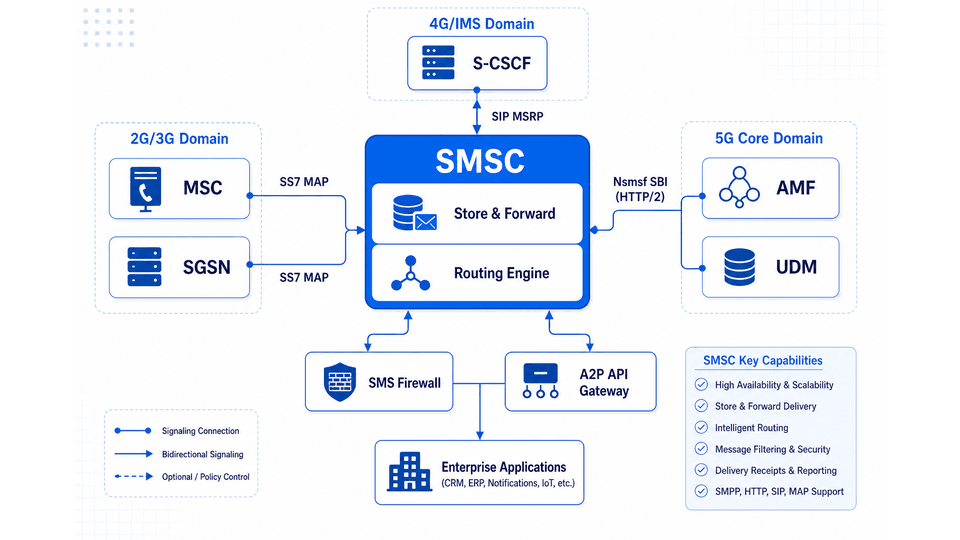
Native MAP signaling for legacy GSM/UMTS networks. Handles MO/MT SMS delivery via MSC/SGSN with full store-and-forward reliability. Backward-compatible with every deployed mobile network on the planet.
IMS-integrated messaging over IP. SMSC registers as an IMS Application Server, receives SIP MESSAGE requests from S-CSCF, and delivers SMS seamlessly to VoLTE subscribers without CS fallback.
Service-based SMS Function for 5G Core. Communicates with AMF and UDM via HTTP/2 REST APIs. Fully cloud-native microservice that scales independently of legacy SMSC components.
Integrated SMS firewall with real-time grey route detection, sender ID spoofing prevention, content filtering, and A2P revenue assurance. Every message is authenticated and classified before delivery — protecting subscribers and revenue simultaneously.
Three Message Flows, One Platform
SMSC handles every SMS use case — from person-to-person texts to high-value enterprise messaging
P2P Messaging
Classic person-to-person SMS. Store-and-forward with retry logic ensures delivery even when the recipient is offline, out of coverage, or roaming. First Delivery Attempt success rate exceeds 98% in optimized networks.
A2P Enterprise Messaging
Application-to-Person SMS for banking, e-commerce, healthcare, logistics, and government. High-throughput APIs with SLA guarantees for OTP delivery (< 2 seconds), bulk campaigns, and transactional notifications.
IoT & M2M Messaging
Machine-to-machine SMS for device management, telemetry, and alerts. Optimized for high-frequency small messages with low power consumption triggers — critical for smart meters, asset trackers, and industrial sensors.
Measurable Messaging Performance
A modern SMSC doesn't just deliver messages — it protects revenue, blocks fraud, and scales on demand
Carrier-grade message processing handles the world's busiest messaging periods — Chinese New Year, Diwali, Eid — without queue buildup or delivery delay. Linear scalability through horizontal node addition.
Optimized routing with intelligent HLR lookup caching. 98%+ of messages delivered on first attempt within half a second. Configurable retry policies for challenging delivery scenarios — roaming, poor coverage, congested cells.
Integrated SMS firewall blocks grey routes and enforces A2P termination fees on day one. Every unauthorized message intercepted is revenue reclaimed. Typical operators see 15-30% A2P revenue increase within the first quarter.
Geo-redundant active-active deployment with message store replication across data centers. No message loss during failover. Independently audited at five-nines availability across production deployments.
The SMS Delivery Pipeline
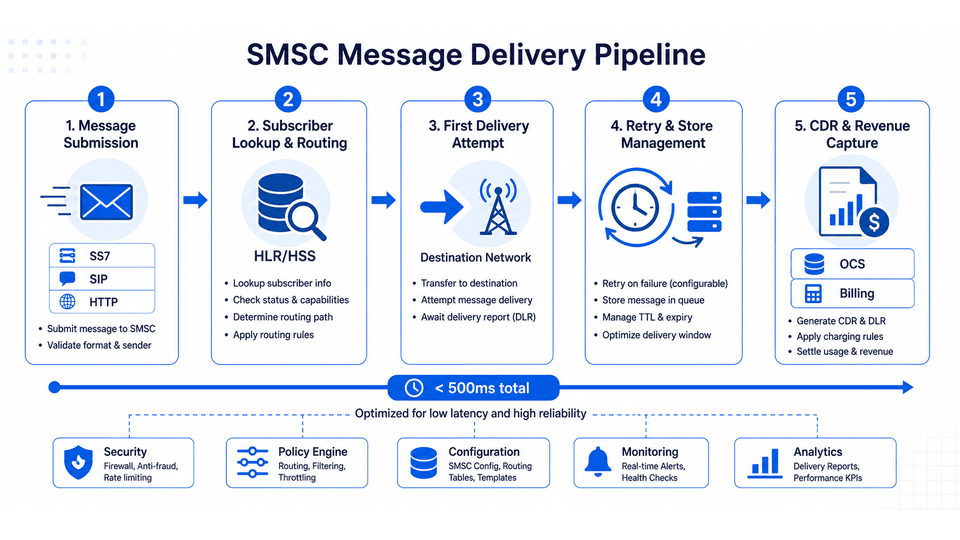
From sender to recipient — every message passes through SMSC's store-and-forward pipeline in under a second
Message Submission
SMS arrives at SMSC via SS7 MAP (MO-ForwardSM), SIP MESSAGE, or HTTP REST API. The message is immediately persisted to the message store — zero risk of loss even if downstream systems are temporarily unavailable.
Subscriber Lookup & Routing
SMSC queries HLR/HSS for the recipient's current MSC/SGSN/AMF location. Intelligent routing selects the optimal delivery path based on network topology, subscriber state, and configured routing policies.
First Delivery Attempt
Message forwarded to the recipient's serving network element via MT-ForwardSM (SS7), SIP MESSAGE (IMS), or Nsmsf service operation (5G). Delivery confirmation is received and logged for CDR generation.
Retry & Store Management
If first attempt fails (subscriber offline, out of coverage), SMSC queues the message with exponential backoff retry. Configurable validity period and retry schedules — from minutes for OTPs to days for person-to-person messages.
CDR & Revenue Capture
Every message event — submission, delivery, failure, expiry — generates a Charging Data Record. Integrated with OCS for real-time prepaid debit and with billing for postpaid invoicing and A2P partner settlement.
Who Relies on Carrier-Grade SMSC
From national mobile operators to enterprise messaging platforms — anyone who needs SMS at scale
Mobile Network Operators
Deliver billions of P2P and A2P messages monthly across 2G, 3G, 4G, and 5G networks from a single SMSC platform. Monetize A2P traffic, protect against fraud, and retire legacy multi-vendor messaging silos.
MVNOs & Light Operators
Launch branded SMS services without building messaging infrastructure. SMSC-as-a-Service with multi-tenant isolation — each MVNO gets dedicated routing, rate limiting, and A2P revenue reporting.
A2P Messaging Aggregators
Connect enterprise customers to mobile subscribers through direct operator SMSC integration. High-throughput APIs, SLA-backed OTP delivery, and transparent delivery reporting for enterprise billing.
Government & Public Safety
National alert systems, emergency notifications, and citizen services. SMSC with location-based broadcast integration (CBC/CBE) ensures critical messages reach every device in affected areas — instantly and reliably.
Frequently Asked Questions
How does ZBensoft SMSC handle SS7 and SIP messaging on one platform?
ZBensoft SMSC implements a unified message processing core with protocol-specific adapters for SS7 MAP (2G/3G), SIP MSRP (4G/IMS), and Nsmsf SBI (5G). The core handles store-and-forward logic, routing, retry, and CDR generation identically regardless of which protocol the message arrived on. Operators manage one platform instead of three, with unified analytics and revenue reporting across all generations.
Can the SMSC block SMS spam and grey routes?
Yes. The integrated SMS firewall module performs real-time content analysis, sender ID reputation checking, grey route detection, and A2P authorization enforcement on every message. Suspicious messages are blocked, quarantined, or rate-limited based on configurable policies. Operators typically see 80%+ reduction in spam complaints and 15-30% A2P revenue uplift within the first quarter of deployment.
What throughput can the SMSC platform handle?
ZBensoft SMSC is designed for carrier-grade throughput — 50,000+ SMS per second per node cluster with linear scalability. The stateless message processing architecture allows operators to add capacity during peak periods (holidays, events) and scale down during normal operations. Production deployments regularly handle 1+ billion messages per day across multiple network generations.
Full-Stack Technology for Your Telecom Business
ZBensoft integrates charging, core network, and AI capabilities to help operators run efficiently and grow sustainably.
Request a Demo