Session Border Controller
Network border element providing security, NAT traversal, QoS, and protocol interworking for VoIP and IMS networks.
Request a DemoAn Open Network Is a Vulnerable Network
VoIP and IMS networks are exposed to the internet. Every call, every SIP message can be an attack vector — without border protection, your network cannot survive in today's threat landscape
DDoS attacks paralyze voice services
Attackers flood network entry points with massive SIP requests. Legitimate calls are rejected, dropped, or cannot connect at all. One successful DDoS can take voice services offline for hours — every minute is lost revenue.
NAT makes VoIP nearly impossible
Enterprise LANs and home broadband universally use NAT. SIP signaling and RTP media cannot route correctly through NAT — users hear nothing but silence. NAT traversal is not optional; it is the prerequisite for VoIP to work.
Multi-vendor interop is a nightmare
Different vendors implement SIP differently — header formats, codec preferences, session timers all vary. When two networks interconnect, protocol mismatches can cause up to 20% call failure rates.
Where SBC Sits in the Network
SBC is deployed at the network border — all voice and video traffic entering or leaving the network must pass through its security inspection and policy enforcement
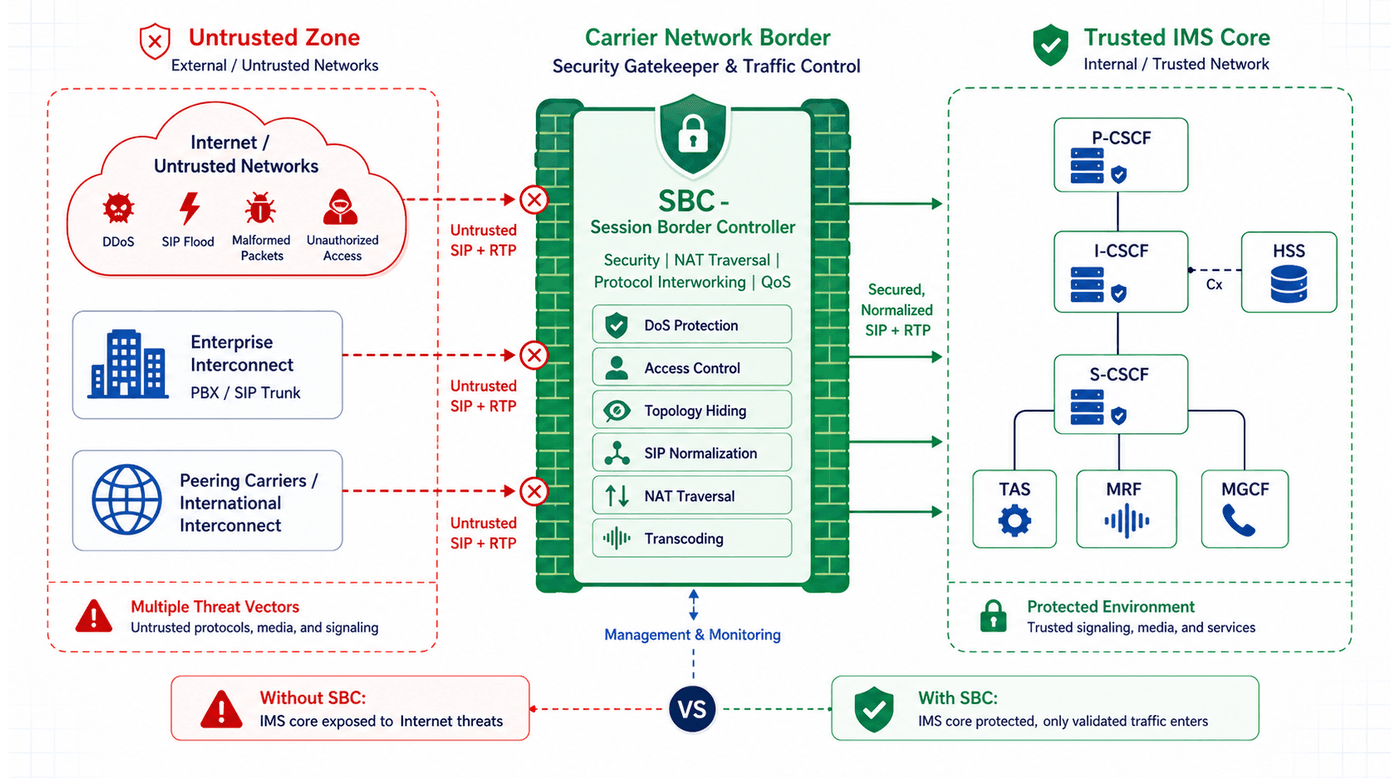
Five Core SBC Capabilities
From security to media handling — SBC is the all-in-one gatekeeper for VoIP and IMS networks
Security Protection
DDoS detection and mitigation, malformed packet filtering, TLS/SRTP encryption, access control lists, signaling rate limiting. Attacks are blocked at the network entry point — protecting internal elements from threats.
NAT Traversal
SIP ALG, STUN/TURN relay, Latching. Whether users sit behind enterprise firewalls or home NAT — SBC ensures call media finds the correct path every time.
Topology Hiding
Hides internal network structure and element addresses from external view. Outside parties only see SBC — unable to probe internal topology. A fundamental security requirement for inter-carrier connectivity.
Protocol Interworking
SIP header normalization, codec negotiation and transcoding, DTMF interworking, IPv4/IPv6 translation. Equipment from different vendors connects seamlessly — SBC acts as the protocol translator.
QoS Assurance
DSCP marking, bandwidth policies, call admission control. Voice quality is prioritized during network congestion — ensuring every call is crystal clear.
With vs Without SBC
The presence of SBC directly determines VoIP network availability, security, and scalability
The Business Value of SBC
SBC is not just a security box — it directly protects revenue, improves user experience, and reduces operational costs
Voice service continuity
SBC protects voice services from DDoS attacks. Operators avoid direct revenue loss and brand damage from service outages — one successful defense justifies the entire investment.
Higher call success rates
NAT traversal and protocol interworking boost cross-network call completion from 80% to nearly 100%. Users never experience "cannot connect" or "cannot hear" — call quality dramatically improves.
Lower interconnect costs
Standardized SIP interworking compresses new partner onboarding from months to days. Operators rapidly expand their interconnect network — every new partner is a new revenue stream.
Who Needs SBC
Any carrier delivering voice and video services over IP — SBC is mandatory infrastructure
VoIP & IMS Carriers
Operators delivering VoLTE, VoWiFi, or enterprise VoIP services. SBC is deployed at the network border as the security gatekeeper for all voice traffic — without SBC, there is no secure voice network.
Enterprise UC Providers
Delivering managed UCaaS and SIP Trunk services to business customers. SBC sits at the enterprise edge — securely connecting on-premises VoIP equipment to the carrier network.
International Carriers
Interconnecting with multiple carriers globally. SBC handles cross-domain SIP normalization, multi-codec support, and security isolation — deploy once, connect worldwide.
Frequently Asked Questions
How is SBC different from a firewall?
Firewalls inspect IP and TCP/UDP headers — operating at L3/L4. SBC understands SIP protocol deeply — parses SIP message bodies, tracks session state, handles RTP media. A firewall cannot distinguish normal SIP traffic from a DDoS attack — SBC can. They are complementary, not substitutes.
Can SBC be deployed as software-only?
Yes. ZBensoft SBC supports pure software deployment — running on commodity servers, VMs, and containers. From compact single-node deployments to carrier-grade clusters — hardware-independent, scale on demand. Cloud-native SBC natively supports horizontal scaling and rolling upgrades.
Does SBC introduce latency?
SBC media processing latency is typically under 1ms — imperceptible to the human ear. Signaling-level processing is in microseconds — the impact on SIP session establishment time is negligible. ZBensoft SBC has been independently tested and proven to have no measurable impact on voice quality (MOS).
Full-Stack Technology for Your Telecom Business
ZBensoft integrates charging, core network, and AI capabilities to help operators run efficiently and grow sustainably.
Request a Demo