Serving Call Session Control Function
Central IMS session controller handling registration, authentication, session routing, and service trigger management.
When Sessions Have No Director
Without a central session controller, every call is a relay race with no baton — services fail, billing breaks, and subscribers leave
Orphaned sessions, dropped calls
Without a session anchor, calls drop during handover between cell towers or during Wi-Fi/LTE transitions. Every dropped call is a frustrated subscriber — and a potential churn statistic.
Services exist but no one triggers them
You invested in a Telephony Application Server, a conferencing platform, a voicemail system. But without iFC-based service triggering, those investments sit idle — calls route directly without ever touching the services subscribers paid for.
Charging gaps that drain revenue
Sessions that start and stop without charging records. Prepaid calls that continue past zero balance. Every unrecorded session is direct revenue leakage — the kind finance discovers at quarter-end.
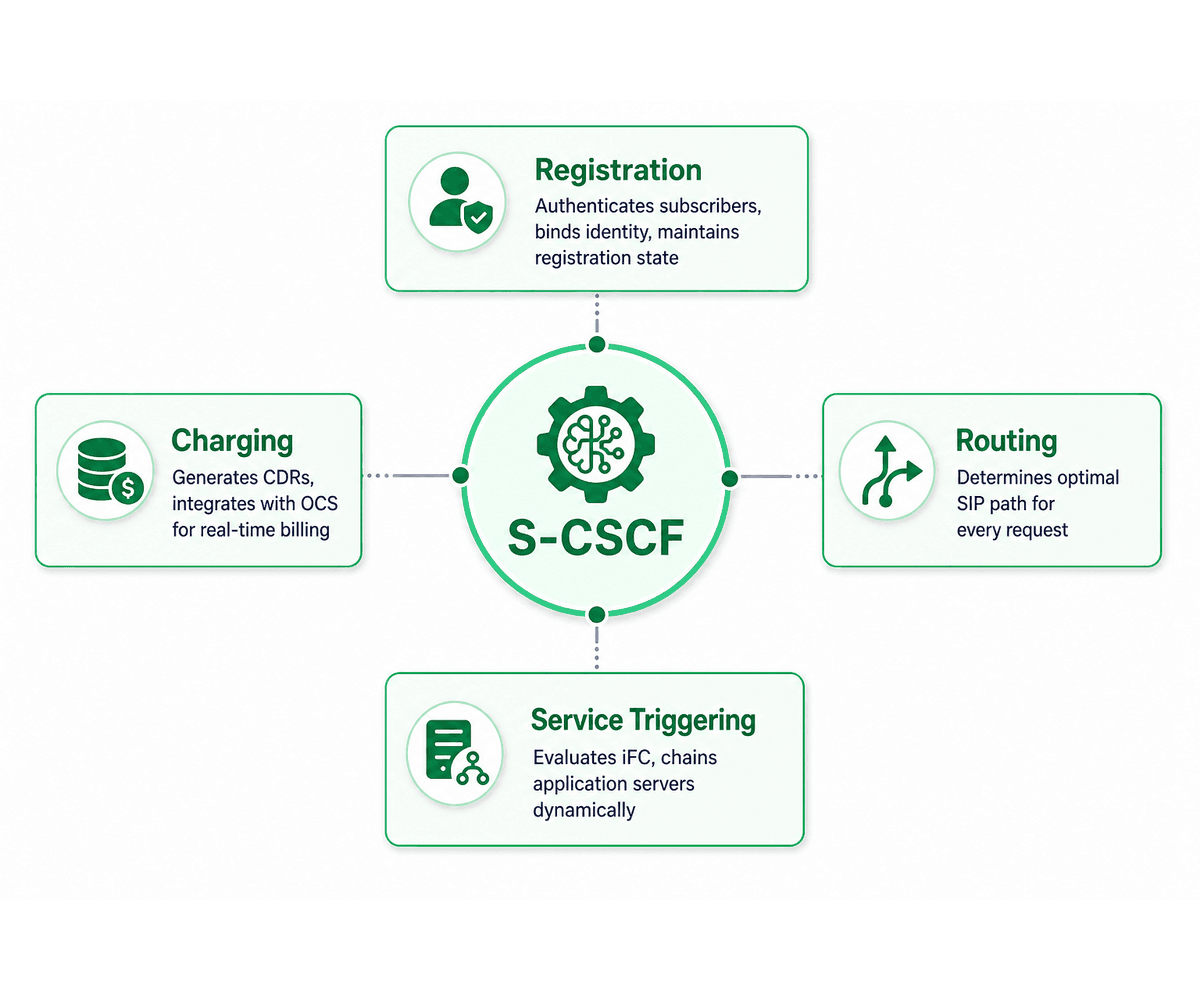
The Session Brain — Four Functions, One Node
S-CSCF unifies four critical control-plane functions that would otherwise require separate, uncoordinated systems
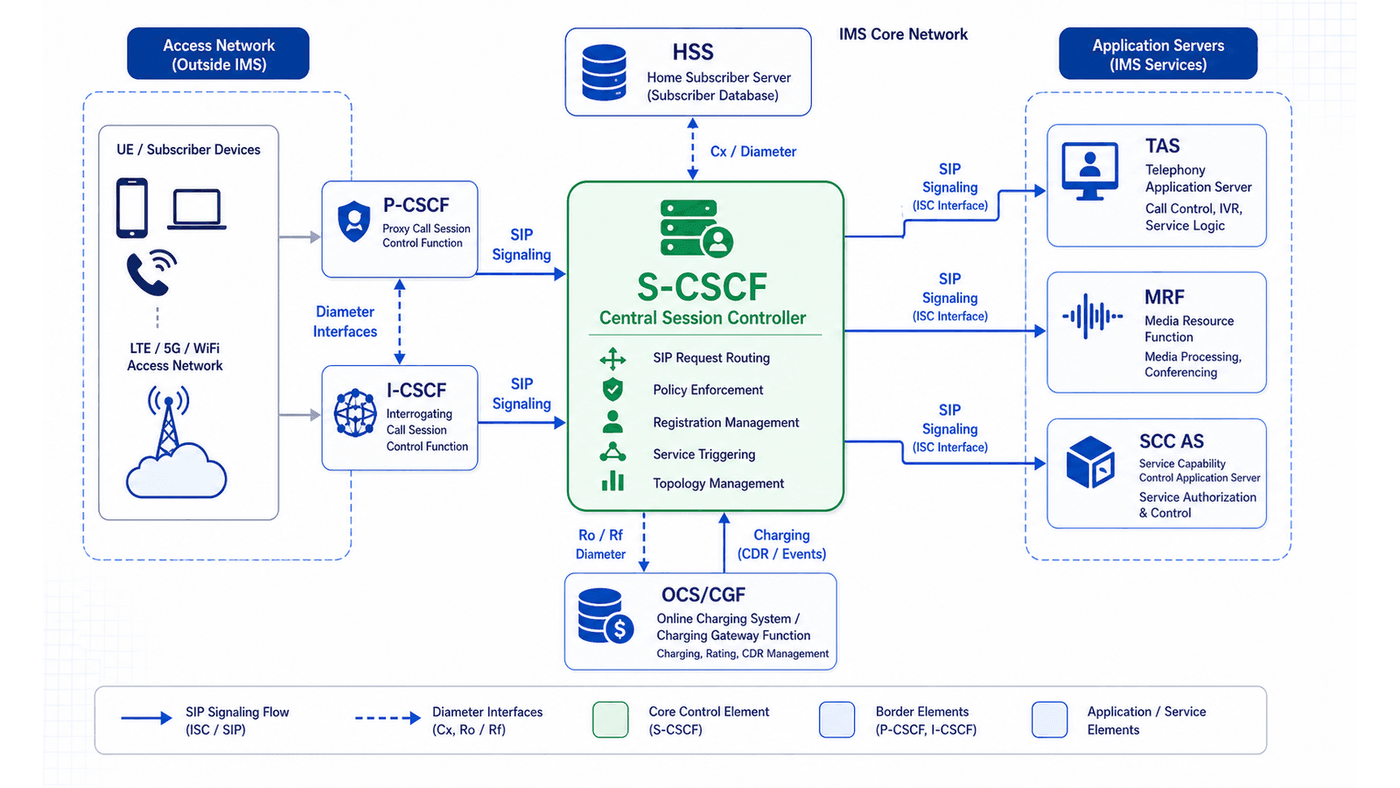
Where S-CSCF Sits in the IMS Core
The central node that every IMS session passes through — S-CSCF sits between the access edge and the application layer
The Session Lifecycle — Five Phases
S-CSCF manages every phase of every IMS session. Click through each phase to see what happens behind the scenes.
Subscriber Registration
Device powers on and sends a SIP REGISTER through P-CSCF and I-CSCF.
S-CSCF queries the HSS via the Cx interface to retrieve authentication vectors and subscriber profile.
After successful authentication, S-CSCF downloads the service profile including Initial Filter Criteria from HSS.
S-CSCF binds the user's public identity to its own address and sends a 200 OK. The subscriber is now registered and service-ready.
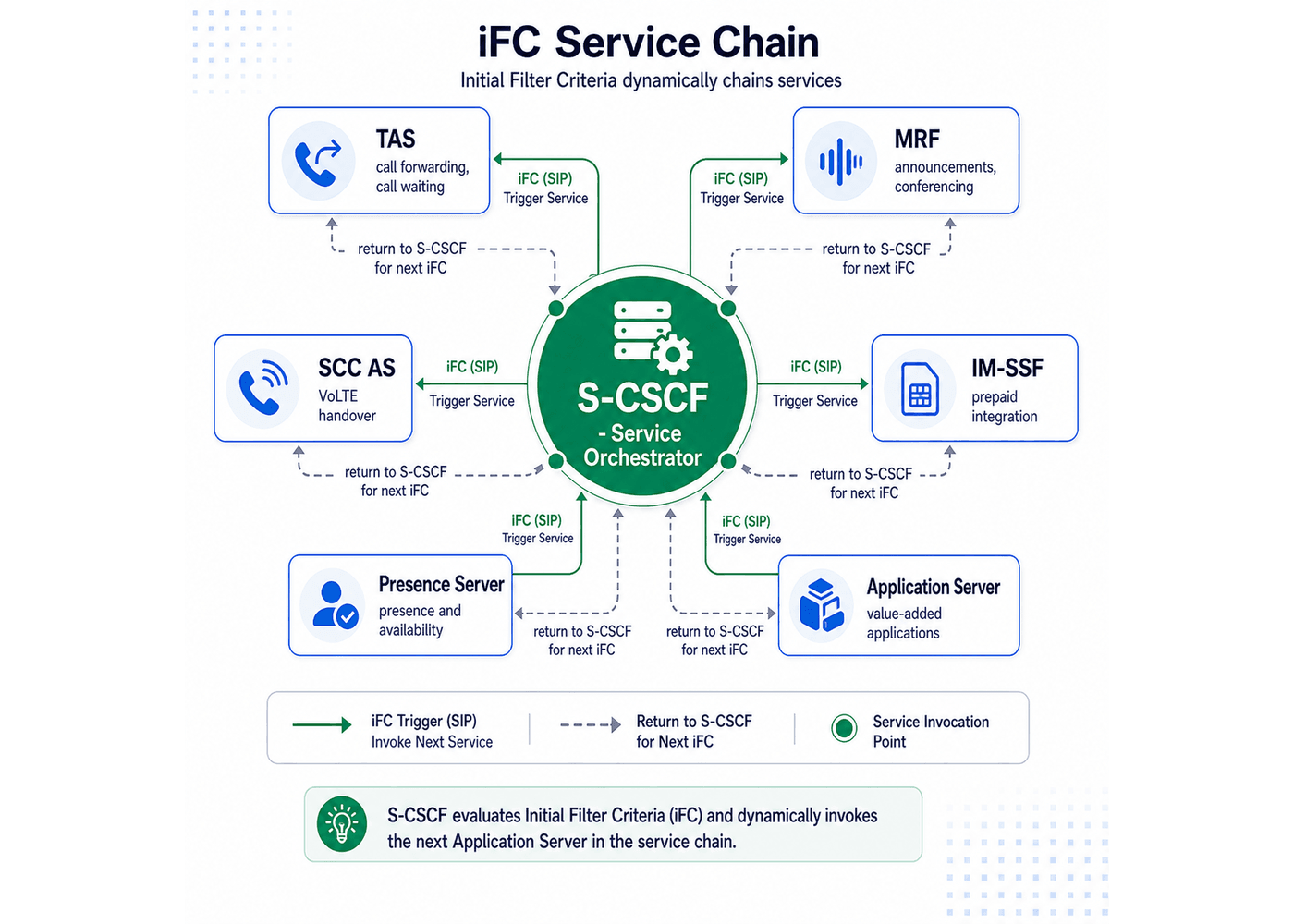
iFC — The Service Chain Engine
Initial Filter Criteria is what makes S-CSCF a service orchestrator, not just a SIP router. It defines exactly which services every subscriber gets — per user, per session, per service.
Each subscriber's iFC is stored in the HSS as part of their service profile. When they register, S-CSCF downloads the iFC and uses it to build a service chain for every subsequent session. The operator defines iFC rules — S-CSCF executes them automatically.
What Operators Gain with S-CSCF
The network-level impact of a central session controller
Who Needs S-CSCF
Mobile Operators Launching VoLTE/VoNR
S-CSCF is the mandatory session control node for IMS-based voice in 4G and 5G networks. Every VoLTE call passes through it.
Fixed Operators Migrating to All-IP
PSTN replacement with SIP-based voice requires an IMS core. S-CSCF provides the session control layer that bridges legacy and IP telephony.
Unified Communications Providers
Enterprise UC platforms integrating voice, video, messaging, and presence need a session controller to orchestrate multi-modal communication sessions.
Wholesale & Carrier Voice Providers
International and wholesale voice carriers need carrier-grade session control to route, charge, and manage millions of inter-carrier voice minutes.
Frequently Asked Questions
What is the difference between S-CSCF and P-CSCF?
P-CSCF is the entry point at the network edge — it handles UE-facing security, NAT traversal, and QoS authorization. S-CSCF is the central session controller deeper in the IMS core — it handles registration with HSS, service triggering via iFC, session routing decisions, and charging correlation. Think of P-CSCF as the security guard at the front door, and S-CSCF as the conductor inside the concert hall.
How does S-CSCF enable faster service launches?
Through Initial Filter Criteria (iFC). New services like call forwarding, conferencing, or RCS are added by updating iFC rules in the HSS — which S-CSCF downloads during subscriber registration. You do not need to reconfigure or restart S-CSCF. The service chain is defined in the subscriber profile, not hardcoded in the network. Operators can launch services for specific subscriber groups by updating HSS data — deploying a new TAS and updating iFC takes hours, not weeks.
Can S-CSCF handle both prepaid and postpaid sessions?
Yes. S-CSCF generates complete CDRs with session timestamps, service invocations, and media details for offline (postpaid) billing. For real-time (prepaid) charging, S-CSCF integrates with the Online Charging System via the ISC interface to reserve credits before session setup and deduct them in real-time during the call. Both models operate simultaneously on the same S-CSCF — differentiated by subscriber profile.
Full-Stack Technology for Your Telecom Business
ZBensoft integrates charging, core network, and AI capabilities to help operators run efficiently and grow sustainably.
Request a Demo