Policy & Charging Rules Function
Real-time policy control and charging rules engine for 4G networks supporting QoS management and fair usage policies.
When Your Network Has No Brain
Without real-time policy control, all subscribers and services share one pipe — peak congestion kills critical services while low-value traffic consumes premium resources
Helpless during network congestion
When video traffic surges during evening peak hours, critical voice services and premium subscribers get dragged down by bulk downloads. Without real-time QoS control, operators watch revenue drain away.
Charging policies rigid as stone
Launching a new data plan or promotion takes weeks of backend configuration changes. Competitors launched the same plan two weeks ago — market responsiveness determines survival.
One pipe, zero differentiation
Premium subscribers and casual users get identical network quality. Cannot differentiate traffic value — high-ARPU VoLTE calls and low-value background downloads compete for the same bearer.
How the Policy Engine Works
PCRF makes real-time decisions every time a subscriber establishes a data session — millisecond response, rules-driven execution
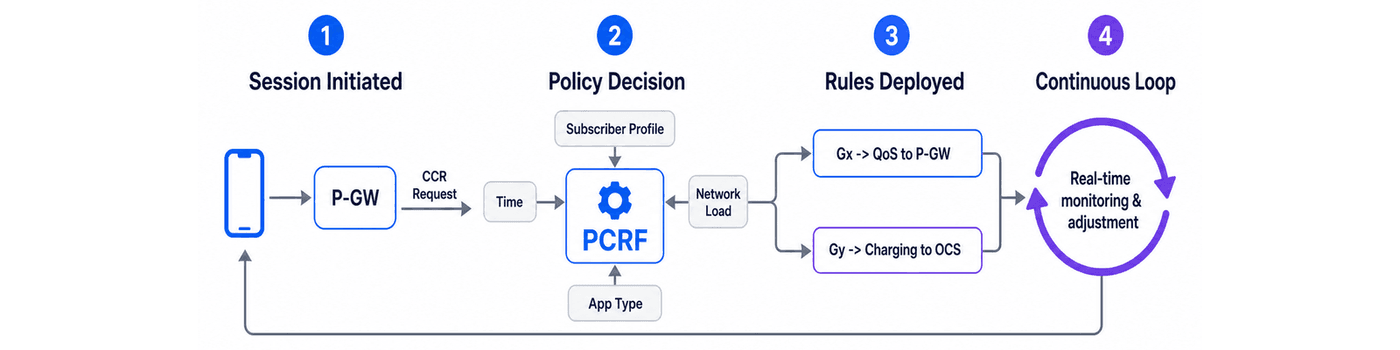
Session initiated
Phone activates data or app launches. P-GW sends a CCR request to PCRF — containing subscriber identity, APN, location, and requested service type.
Policy decision
PCRF matches the optimal policy across its rules engine using subscriber profile, current time, network load, and application type — hundreds of rules traversed and decided in milliseconds.
Rules deployed
PCRF pushes QoS policy to P-GW via Gx interface and charging rules to OCS via Gy interface. One decision, two paths, simultaneous enforcement.
Continuous loop
When a subscriber hits usage thresholds or network load shifts, PCRF adjusts policies in real time — throttle, switch charging tier, or release resources. Policy is a continuous closed loop.
Static Config vs. Real-Time Policy
The operational difference between manual configuration and ZBensoft dynamic policy engine
Traditional
Network policies updated monthly. New plan launches require weeks of configuration windows and late-night maintenance slots.
ZBensoft
New policies live in minutes. Visual rule editor — drag, drop, deploy. No coding, no maintenance windows.
Traditional
No automated response to peak congestion. Operations teams manually adjust QoS parameters — reaction time measured in hours.
ZBensoft
Network load hits threshold → automated throttling or rate-limiting triggers. System decides and enforces in seconds — zero human intervention.
Traditional
One-size-fits-all — same rules for every subscriber, every app, every time slot. No ability to differentiate value.
ZBensoft
Multi-dimensional policies — combine subscriber tier, app type, time window, and network location for granular rules. Monetize every megabyte.
The Business Returns of a Policy Engine
PCRF upgrades operators from "selling bandwidth" to "selling experience"
Elevated premium experience
Guaranteed QoS priority for high-ARPU subscribers — smooth video, crystal-clear VoLTE. Differentiated experience drives higher retention and NPS.
Optimized network utilization
Intelligently throttle low-priority traffic during peak hours while protecting critical services. Support more subscribers and revenue with the same capacity.
Accelerated time-to-market
Visual policy editor compresses new plan launches from weeks to days. Respond to competitive moves instantly — first-mover advantage converts to growth.
Four Capability Dimensions
PCRF policy capabilities span subscriber, application, network, and business dimensions
Subscriber-tier differentiation
Assign differentiated QoS based on subscriber profiles and plan tiers. VIP subscribers get priority access and guaranteed bandwidth — premium users feel the difference.
Application-aware policies
Deep traffic classification — distinguish video, gaming, VoLTE, downloads, browsing. Prioritize latency-sensitive apps, rate-limit background downloads.
Dynamic congestion management
Real-time monitoring of cell and core network load. When congestion hits, automatically execute predefined degradation policies — throttle low-value first, protect critical last.
Flexible charging integration
Deep OCS integration enables policy-driven charging. When subscribers hit plan limits, auto-switch charging mode, trigger notifications, or guide upgrade purchases.
Who Needs PCRF
Any 4G operator ready to upgrade from "dumb pipe" to "intelligent experience"
Mobile Network Operators
Large-scale 4G networks serving millions of subscribers. PCRF is the key investment for differentiated services and preventing premium subscriber churn.
MVNOs
Branded services over host networks. PCRF enables MVNOs to implement independent policy control and differentiated services on shared infrastructure.
IoT Service Providers
Managing massive device fleets with diverse traffic patterns. PCRF delivers differentiated QoS per IoT vertical — high reliability for telemedicine, low bandwidth for metering.
Frequently Asked Questions
What is the difference between PCRF and PCF?
PCRF is the policy control function for 4G LTE, interacting with P-GW and OCS via Diameter protocol. PCF is the policy function for 5G, interacting with SMF and CHF via HTTP/2. ZBensoft provides a unified policy platform — the same visual editor manages both 4G PCRF and 5G PCF rules.
Does deploying PCRF require network changes?
PCRF integrates via standard Gx/Gy interfaces with existing P-GW and OCS. If your network has 3GPP-compliant P-GW and OCS, PCRF deployment requires only interface configuration — no existing network elements need replacement.
Do policy updates interrupt service?
ZBensoft PCRF supports online hot-reload — new policy rules load and take effect instantly without service restart, without impacting active subscriber sessions. All policy changes have complete audit trails and rollback capability.
Full-Stack Technology for Your Telecom Business
ZBensoft integrates charging, core network, and AI capabilities to help operators run efficiently and grow sustainably.
Request a Demo