Proxy Call Session Control Function
SIP proxy serving as the first contact point for IMS terminals, handling registration, security, and QoS management.
Your IMS Edge Has No Guard
Without a dedicated security proxy at the network edge, your IMS core is exposed to threats, fraud, and service outages that directly impact revenue
SIP-based attacks go unchallenged
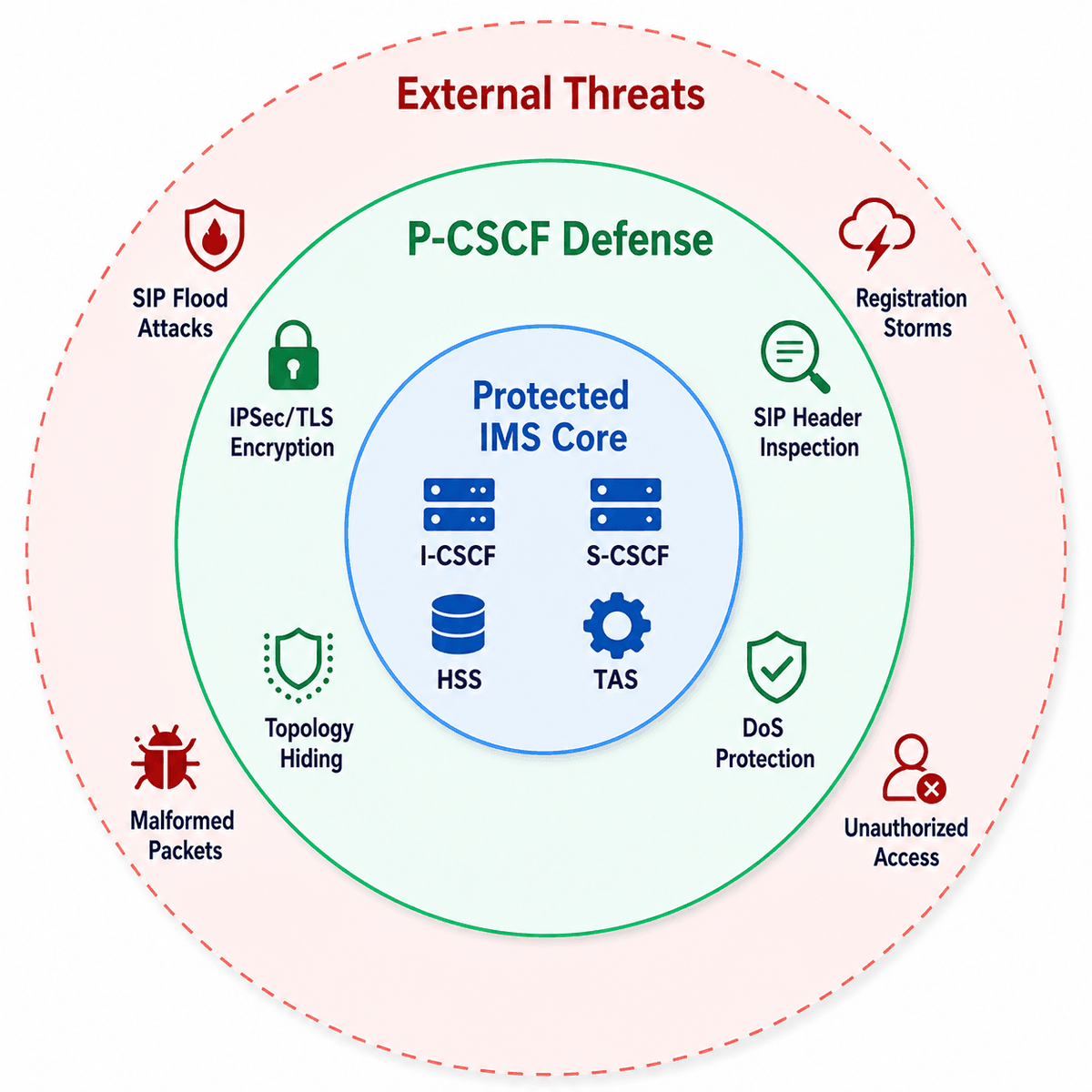
SIP flood attacks, registration storms, and malformed packets hit your IMS core directly. Without a security perimeter, every attack reaches critical infrastructure — one successful breach means nationwide VoLTE outage.
QoS without enforcement is just hope
Premium subscribers expect guaranteed call quality, but without bearer-level QoS authorization at the edge, HD voice degrades to narrowband the moment the network gets busy. Premium pricing without premium delivery.
Emergency calls can't find help
When a subscriber dials emergency services, the network must prioritize the call, inject location data, and route to the nearest PSAP — all in milliseconds. Without P-CSCF emergency handling, lives are at risk and regulatory fines follow.
The Three-Layer Security Perimeter
P-CSCF creates a defense-in-depth architecture that stops threats before they reach the IMS core
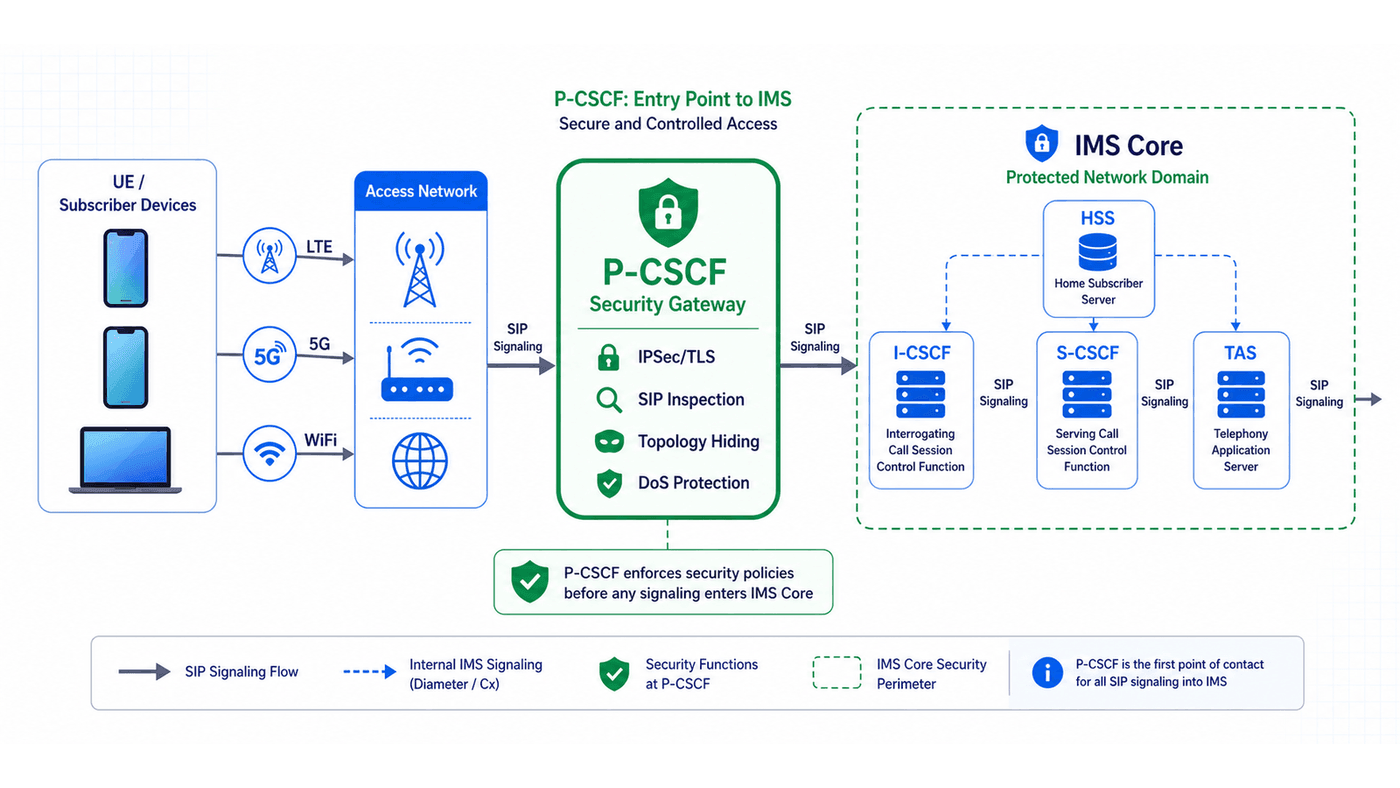
Where P-CSCF Sits in Your Network
The first touchpoint for every SIP session — P-CSCF is the gateway between the access network and the IMS core
The SIP Session Journey — What P-CSCF Does at Every Step
From registration to call termination, P-CSCF is the constant in every IMS session — inspecting, enriching, and protecting at every stage
Phone powers on and sends a SIP REGISTER. P-CSCF establishes an IPSec tunnel, verifies the device identity, and forwards the registration to I-CSCF for S-CSCF assignment. The secure session is now anchored.
Subscriber dials a number. P-CSCF receives the SIP INVITE, validates the request against the security association, enriches it with access network information (cell ID, RAT type), and routes it toward the called party via the IMS core.
As the call negotiates media parameters, P-CSCF interfaces with PCRF/PCF via the Rx interface to authorize dedicated bearers. It ensures the HD voice codec gets guaranteed bandwidth — not best-effort delivery.
Throughout the call, P-CSCF timestamps every significant event — session start, media changes, QoS updates, session end. These records feed the operator's billing system for accurate per-call charging and roaming settlement.
When either party hangs up, P-CSCF processes the SIP BYE, releases the dedicated bearer via PCRF, finalizes the CDR, and tears down the IPSec association cleanly. Resources are freed instantly for the next session.
One Proxy, Two Personalities
P-CSCF handles normal VoLTE calls and emergency calls with completely different logic — intelligent enough to know which is which in milliseconds
Normal VoLTE Call
Standard SIP proxy behavior — route via IMS core to the called party. Full QoS authorization, billing, and media negotiation.
- Routes through full IMS core (I-CSCF → S-CSCF → TAS)
- Applies QoS authorization for HD voice quality
- Generates complete CDRs for billing and settlement
- Supports supplementary services (call waiting, forwarding, conferencing)
Emergency Call (E911 / E112)
Bypasses normal IMS routing entirely. P-CSCF detects emergency URIs, prioritizes the call, injects location, and routes directly to the nearest emergency center.
- Detects emergency SIP URIs and priority headers instantly
- Injects geolocation (cell ID, GPS coordinates) into the SIP request
- Routes directly to E-CSCF — bypasses normal S-CSCF/TAS processing
- Reserves bearer resources with absolute priority — preempts other calls if necessary
Measurable Impact at the Network Edge
What operators gain when P-CSCF guards the IMS front door
Carrier-grade availability with geo-redundant P-CSCF clusters. No single point of failure — VoLTE stays up even if a data center goes down.
Sub-millisecond header inspection and forwarding. Subscribers experience zero perceptible delay in call setup — the proxy is transparent.
Topology hiding strips internal network topology from every SIP message. Attackers see a single IP — they never discover what's behind the proxy.
Dedicated emergency call handling with priority resource reservation. Every emergency call gets through — regulatory compliance guaranteed.
Who Needs P-CSCF
Mobile Network Operators
Any operator launching VoLTE or VoNR services. P-CSCF is not optional — it's the mandatory entry point required by 3GPP standards for IMS-based voice services.
MVNOs with IMS Services
MVNOs offering VoLTE and rich communication over host networks. A dedicated P-CSCF enables independent security policies and QoS control on shared infrastructure.
Fixed-Line Operators
Fixed operators migrating from PSTN to all-IP voice. P-CSCF bridges SIP endpoints (desk phones, ATAs) to the IMS core with the same security model as mobile.
Emergency Services Authorities
Government agencies responsible for public safety communications. P-CSCF ensures emergency calls are prioritized, located, and routed to the correct PSAP every time.
Frequently Asked Questions
Is P-CSCF the same as an SBC (Session Border Controller)?
They overlap in function but serve different roles. An SBC is typically deployed at the operator-to-operator border (interconnect) and handles media transcoding, while P-CSCF is the UE-to-IMS entry point focused on SIP signaling security, registration anchoring, and QoS authorization. Many vendors combine both functions — ZBensoft P-CSCF includes integrated SBC capabilities for access-side media handling and NAT traversal.
Does P-CSCF work with 5G standalone (VoNR)?
Yes. P-CSCF is fully compatible with 5G standalone architecture. For VoNR, P-CSCF interfaces with the 5G PCF instead of PCRF for QoS authorization. The SIP signaling layer remains identical — operators can run the same P-CSCF for both VoLTE (4G) and VoNR (5G) subscribers during migration.
How does P-CSCF handle NAT traversal for VoWiFi?
VoWiFi (Wi-Fi Calling) users are often behind consumer-grade NATs that break SIP signaling. ZBensoft P-CSCF includes integrated NAT traversal — it maintains UDP keepalives to keep NAT bindings open, performs SIP header manipulation to replace private IPs with public ones, and can anchor media through a built-in relay for cases where direct media paths fail.
Full-Stack Technology for Your Telecom Business
ZBensoft integrates charging, core network, and AI capabilities to help operators run efficiently and grow sustainably.
Request a Demo