Network Slice Selection Function
5G network slice selection function enabling intelligent selection of network slice instances for diverse service requirements.
The Era of One-Network-Fits-All Is Over
4G treats all devices equally. But in 5G, autonomous driving needs 1ms latency, smart meters need 10-year batteries, and VR streaming needs 10Gbps — one network cannot serve all
One-size-fits-all network design
4G was optimized for smartphones — every device shares the same architecture. When IoT explodes from millions of smart meters to thousands of factory robots, the same network parameters simply cannot adapt.
SLA differentiation impossible
Without network slicing, operators offer only one service level. High-value enterprise customers and casual consumers share identical network quality — no way to provide premium experience to those willing to pay.
Slow new service rollout
Setting up dedicated network services for enterprise customers takes months of planning and deployment. Without slicing, each new use case requires a separate physical network — expensive, slow, and unscalable.
How NSSF Routes Traffic
NSSF is the intelligent dispatcher of 5G — reading each device's S-NSSAI label and routing it to the matching network slice
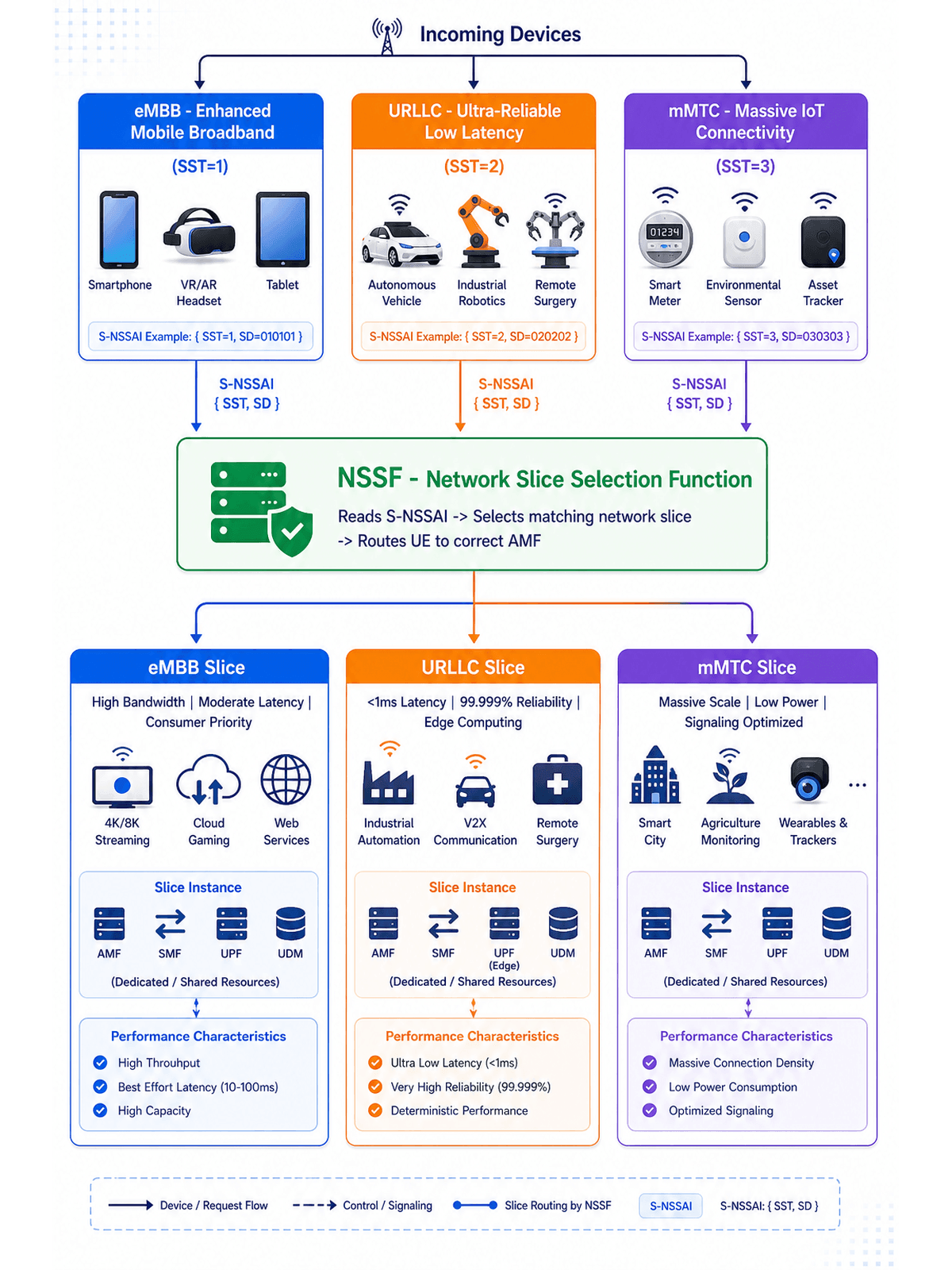
eMBB — Enhanced Mobile Broadband
For consumer smartphones, VR/AR, HD video. Needs high bandwidth, moderate latency. NSSF routes them to the eMBB slice — network resources optimized for throughput.
URLLC — Ultra-Reliable Low Latency
For autonomous driving, remote surgery, industrial automation. Needs <1ms latency and 99.999% reliability. NSSF routes them to the URLLC slice — edge computing nodes deployed nearby.
mMTC — Massive IoT
For smart meters, environmental sensors, asset tracking. Massive device count, low bandwidth, low power. NSSF routes them to the mMTC slice — optimized for signaling efficiency and power saving.
4G Unified Network vs 5G Sliced Network
Network slicing is not just virtualization — it is the technology that upgrades operators from "selling pipes" to "selling services"
The Business Value of Network Slicing
NSSF lets operators turn one physical network into multiple virtual network products — each with independent pricing and customer segments
New revenue streams
Offer dedicated network slices to enterprise customers — SLA-committed, performance-verifiable, usage-measurable. Expand from consumer-only to B2B slice services — operators unlock entirely new enterprise revenue.
Maximum resource efficiency
One network serves consumers, enterprises, and IoT simultaneously. Slice isolation and elastic scaling dramatically improve utilization — surplus capacity is precisely allocated to slices that need it.
Minutes-to-service
New enterprise customer slice activation shrinks from months to minutes. Operators respond to market opportunities instantly — sign today, live today, first-mover advantage.
NSSF Core Capabilities
From slice selection to lifecycle management — NSSF is the control center for 5G slice operations
Intelligent Slice Selection
Receives slice selection requests from AMF, matches UE-subscribed S-NSSAI against current slice availability per location, returns optimal slice instance list — all in milliseconds.
Slice Instance Management
Maintains a global view of all active slices in the network — NSI ID, service area, capacity status for each. NSSF is the operator's single pane of glass for slice resource visibility.
Access Control Policies
Configures slice visibility and access permissions per PLMN and Tracking Area. Ensures slices in one region cannot be accessed by devices from unrelated regions — the gatekeeper for security and resource isolation.
5G-AUSF Authentication
Collaborates with AUSF to verify device slice access rights. The S-NSSAI a device requests must match its subscription data — NSSF and AUSF together ensure only authorized devices reach the correct slice.
Who Needs NSSF
NSSF is mandatory for network slicing in 5G SA deployments — without NSSF, there is no slicing
5G SA Operators
Mobile operators deploying 5G Standalone with differentiated services. NSSF is the core enabler for network slicing monetization — turning one network into many products.
Industry Private Network Providers
Delivering 5G private network solutions for manufacturing, healthcare, transportation. NSSF enables serving multiple industry clients on the same infrastructure — one slice per customer.
5G Application Developers
Building apps requiring specific network performance — VR/AR, autonomous driving, remote control. Request dedicated slice resources via standard APIs for predictable network quality.
Frequently Asked Questions
How is NSSF different from traditional VLANs?
VLANs isolate traffic at Layer 2 — simple broadcast domain separation. NSSF is a 5G core network function that goes far beyond: end-to-end slicing (radio to core), SLA guarantees, dynamic lifecycle management, deep integration with 5G subscription data. VLANs are a network isolation tool; NSSF is a Network-as-a-Service operations platform.
Can 5G be deployed without NSSF?
Yes, 5G can be deployed without NSSF, but network slicing is impossible without it. NSSF is technically optional in 5G SA specifications — but without it, you lose 5G's most critical commercial differentiator. Operators who only need a unified network (similar to 4G mode) can skip NSSF. But any operator planning to monetize 5G slicing must deploy it.
How many slices can one operator support?
ZBensoft NSSF supports operators in defining and managing hundreds of network slice instances. The actual number depends on network scale, spectrum resources, and business needs. In typical deployments, operators configure slices for consumers (1-2), enterprises (5-20), and IoT (10-50), scaling dynamically as business grows.
Full-Stack Technology for Your Telecom Business
ZBensoft integrates charging, core network, and AI capabilities to help operators run efficiently and grow sustainably.
Request a Demo