Network Repository Function
5G service discovery and registration function enabling dynamic network function discovery in service-based architecture.
The Biggest Bottleneck in 4G: Static Connections
In 4G, every network element connection is hard-coded. Adding a single node requires changing configs across the entire network — an operating model unacceptable in the cloud-native era
Configuration hell
Every NF in 4G must be pre-configured with the IP addresses and ports of its peers. Adding one P-GW instance means updating configs on MME, HSS, PCRF, and OCS — individually. One change, days of windows, late-night cutovers.
Failure-blind, traffic keeps flowing
When an NF instance goes down, other nodes have no idea — traffic is still sent to the dead instance until timeout. No heartbeat detection, no automatic failover. Operations teams stare at alert screens and react manually.
Scaling = touching every node
Scaling up is not just spawning new instances. The new instance must be "known" to its peers before it can receive traffic. In 4G, this means a cascade of config change windows — scaling speed is locked to config update speed.
How NRF Changes Everything
NRF is the central hub of 5G Service-Based Architecture — every NF registers on startup, queries NRF when it needs to call another NF. Zero configuration, dynamic discovery
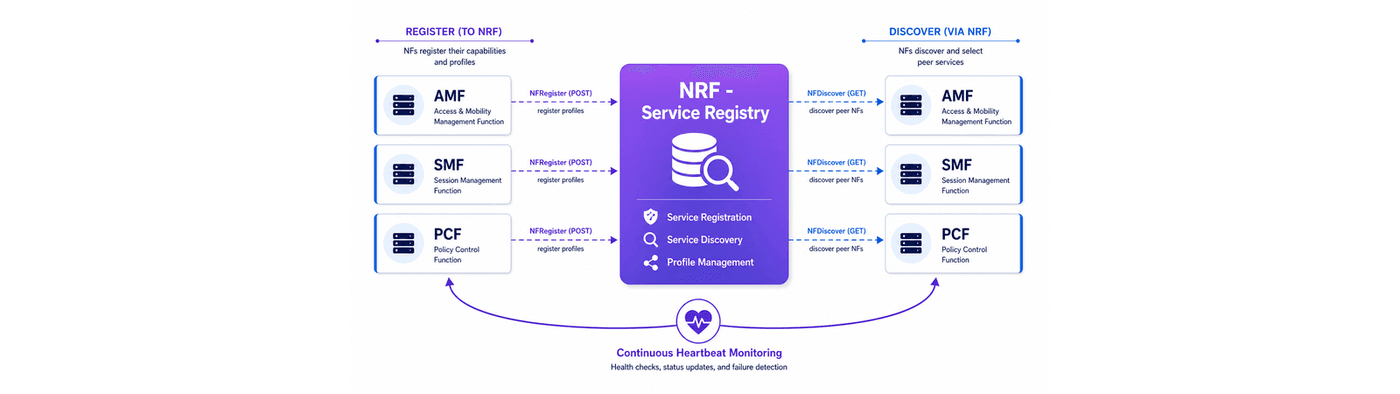
NF registers on startup
SMF starts up and sends a registration request to NRF with its NF type, instance ID, capacity, supported API versions, and callback address. NRF validates its identity and adds it to the service directory.
NF queries for discovery
AMF needs an SMF to serve a new PDU session. It queries NRF: "Which SMFs are available?" NRF returns the optimal instances based on SMF load, location, and capabilities.
Heartbeat keepalive
Every NF sends periodic heartbeats to NRF. If heartbeats stop, NRF marks that instance as unavailable and removes it from the directory — other NFs stop sending requests to it.
Elastic scaling
During a traffic spike, newly launched SMF instances auto-register with NRF and immediately start receiving traffic. When idle, instances gracefully deregister — NRF ensures in-flight requests complete before removal. Scaling in and out requires zero human intervention.
4G Hard-Coded vs 5G Dynamic Discovery
The fundamental difference between two architectural models — not a tech upgrade, an operational revolution
Every NF pre-configured with peer addresses. Network topology is hard-coded into config files.
NFs register on startup, deregister on shutdown. Topology is dynamic, configuration is real-time.
Fault detection relies on timeouts — requests sent to dead nodes, waiting seconds before unreachable.
NRF continuously monitors NF heartbeats. Failed instances removed from directory in seconds, traffic auto-rerouted.
Scaling new instances requires manual configuration and maintenance windows. Weeks from decision to production.
New instances register on startup, ready to serve immediately. Minutes from decision to production — true elastic scaling.
The Business Value of Service Discovery
NRF enables true cloud-native agility for 5G core — this is the infrastructure for digital transformation
Zero-touch operations
Network functions auto-register and discover each other, eliminating manual configuration errors and delays. Operations teams upgrade from "config managers" to "network architects" — managing policies instead of maintaining config tables.
Elastic scaling enabled
During promotions or traffic surges, the core network auto-scales to absorb demand. NRF ensures new instances are instantly discovered and utilized — no need to pre-provision redundant capacity. Resource utilization dramatically improves.
Self-healing
NF failures detected and isolated in seconds — traffic stops flowing to dead nodes. The system recovers before subscribers notice anything. This is the capability that moves operator SLAs from four nines to five nines.
NRF Capability Matrix
From registration to discovery, from monitoring to orchestration — NRF provides complete lifecycle management for 5G Service-Based Architecture
Service Registration
All 5G NFs register identity and capability information with NRF on startup. NRF maintains a complete profile for each NF — type, version, capacity, supported features, and API endpoints.
Intelligent Discovery
NFs query NRF to find available instances of needed services. NRF performs smart matching based on load, topology proximity, and NF capabilities — returning optimal, not random, results.
Health Monitoring
Real-time health detection via heartbeats. NRF tracks every NF's operational state, automatically isolates failed instances. Supports graceful deregistration — ensures in-flight requests complete before removal.
Policy-Based Selection
Policy-driven NF selection — prefer same-location instances, avoid high-load nodes, isolate NF resources per slice type. Network intelligence starts at the service discovery layer.
Who Needs NRF
NRF is mandatory for every 5G Standalone deployment — without NRF, there is no Service-Based Architecture
5G SA Operators
Mobile operators deploying 5G Standalone. NRF is a foundational infrastructure component for every 5G core deployment — like DNS is for the internet.
5G Private Network Providers
Delivering private 5G solutions to enterprises. Even in compact deployments, NRF handles NF discovery and health management — same role regardless of scale.
Cloud-Native Telecom Platforms
Building Kubernetes-based telecom cloud platforms. NRF is the service registry for the microservices architecture — complementary to K8s Service Discovery with carrier-grade enhancements.
Frequently Asked Questions
How is NRF different from DNS?
DNS resolves domain names to IP addresses — simple mechanism: query once, cache the result. NRF is far more powerful: maintains complete NF profiles (capabilities, capacity, state), policy-based intelligent selection, continuous heartbeat monitoring, NF lifecycle management. NRF is a purpose-built service discovery system for telecom networks.
Will the network collapse if NRF goes down?
ZBensoft NRF supports active-active geo-redundant deployment. NFs also maintain a local cache — after initial discovery, peer information is cached locally. Even if NRF is briefly unreachable, established NF-to-NF communication continues uninterrupted. New registration and discovery operations pause, but running services are unaffected.
Does an EPC network need NRF?
No. NRF is a component of the 5G Core Service-Based Architecture. 4G EPC uses point-to-point interfaces with pre-configured NF connections. NRF is only needed when deploying 5G Standalone (SA) — it is the key enabler for 5GC's evolution from monolith to microservices.
Full-Stack Technology for Your Telecom Business
ZBensoft integrates charging, core network, and AI capabilities to help operators run efficiently and grow sustainably.
Request a Demo