Media Resource Function
IMS media processing function supporting announcements, conferencing, transcoding, and interactive voice/video services.
The Media Fragmentation Challenge
Without a unified media processing platform, operators face escalating costs, service delays, and integration nightmares
Vendor Media Silos
Each application server (VoLTE, conferencing, IVR) requires its own media processing hardware — creating incompatible silos, wasted capacity, and redundant maintenance costs across the network.
Common Media Platform
A single MRF serves all application servers simultaneously. One platform handles transcoding, conferencing, announcements, and streaming — eliminating hardware duplication and reducing CapEx by up to 40%.
Codec Incompatibility
Endpoints use different codecs — AMR-WB for VoLTE, OPUS for WebRTC, G.711 for PSTN. Without media adaptation, calls fail or quality degrades between different network segments.
Universal Transcoding Engine
Real-time transcoding between any codec pair — AMR, EVS, OPUS, G.711, G.729, VP8, H.264. Seamless media flows across VoLTE, VoWiFi, WebRTC, and legacy PSTN without quality loss.
Slow Service Launch
Launching a new media service (video mail, HD conferencing, IVR) requires procuring, testing, and integrating new media hardware — adding months to time-to-market and delaying revenue.
Service-Ready Media Pool
New applications connect to the existing MRF via standard SIP interfaces. Launch video ringback tones or HD conferencing in weeks, not months — the media processing capacity is already deployed.
Media Processing Capabilities
Six core media functions on one unified platform — everything applications need to deliver rich multimedia experiences
Media Transcoding
Real-time audio and video codec conversion between any standards. AMR, EVS, OPUS, G.711, G.729, VP8, H.264 — adaptive bitrate and format negotiation for every session.
Audio Conferencing
Multi-party audio mixing with up to hundreds of participants per conference. Dynamic speaker detection, noise reduction, and seamless join/leave — carrier-grade conferencing for enterprise and consumer services.
Announcements & IVR
Playback of pre-recorded announcements, tone generation, and interactive voice response. Supports multi-language prompts, dynamic message insertion, and personalized caller experiences.
DTMF & Tone Handling
In-band and out-of-band DTMF detection and generation. Supports RFC 2833 telephone events, SIP INFO, and in-band tone relay — critical for IVR navigation and legacy interworking.
Video Processing
Video transcoding, mixing, and streaming for video mail, video ringback tones, and video conferencing. H.264 and VP8 codec support with adaptive resolution and frame rate control.
Speech Services
Speech recognition and text-to-speech synthesis for advanced IVR and accessibility services. MRF provides the media processing backend for voice-driven self-service and smart assistants.
MRFC + MRFP: Dual-Engine Architecture
Control and media planes work together — MRFC interprets application intent, MRFP executes media processing at carrier scale
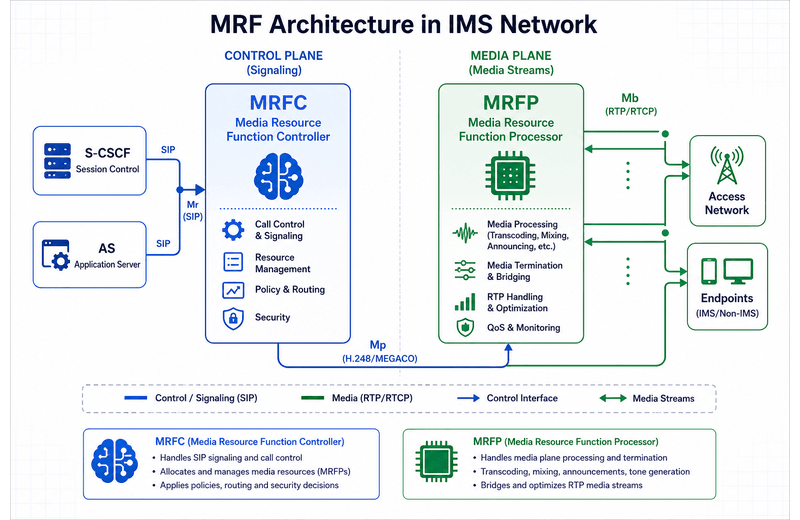
MRFC
Control PlaneThe MRFC interprets SIP signaling from application servers and translates service logic into media processing commands for the MRFP.
- Receives SIP requests from S-CSCF and Application Servers via the Mr interface
- Interprets service logic — conferencing, announcements, transcoding — and maps to media resources
- Controls MRFP via Mp interface using H.248/MEGACO or IRCP protocol
- Manages media resource allocation, session state, and billing correlation
MRFP
Media PlaneThe MRFP executes the actual media processing — mixing audio streams, converting codecs, playing announcements, and detecting DTMF tones in real time.
- Processes RTP media streams — audio mixing, video transcoding, stream replication
- Generates and plays IVR prompts, tones, and announcements in multiple languages
- Detects DTMF digits via RFC 2833, SIP INFO, or in-band tone analysis
- Provides media quality reporting, jitter buffering, and adaptive rate control
Business Value Impact
Measurable improvements across cost, speed, quality, and reliability when operators deploy a unified MRF
Consolidate media processing into one platform instead of buying dedicated hardware for each application — savings compound with every new service launched.
New media services go live in weeks by connecting to the existing MRF pool — no hardware procurement, no platform integration, no capacity planning delays.
Carrier-grade HA with geo-redundancy and N+K sparing. Media sessions survive individual component failures — subscribers never experience dropped conferences or failed IVR.
Any codec, any access network, any device. MRF bridges VoLTE, WebRTC, PSTN, and 5G media without quality degradation — universal reach for every subscriber.
IMS Services Powered by MRF
Every rich multimedia service in the IMS ecosystem depends on MRF for media processing — it is the engine behind the user experience
HD Voice (VoLTE)
Transcoding and media anchoring for crystal-clear voice calls across 4G, 5G, and WiFi access networks.
Rich Messaging (RCS)
Video messaging, voice notes, and multimedia sharing — MRF handles codec adaptation and media storage.
HD Conferencing
Multi-party audio and video mixing, speaker detection, and dynamic participant management at carrier scale.
Video Mail & VMS
Video recording, playback, transcoding, and storage — subscribers access voicemail in any format on any device.
Ringback Tones (CRBT)
Personalized audio and video ringback — MRF streams media content to callers with zero call setup delay.
Deployment & Delivery Assurance
ZBensoft MRF is built for carrier operations — cloud-native, highly available, and standards-compliant
Cloud-Native & Virtualized
- Deploy as VNF on OpenStack or CNF on Kubernetes
- Elastic scaling — add capacity in minutes during traffic peaks
- CI/CD pipeline for zero-downtime upgrades and rollbacks
Carrier-Grade Reliability
- N+K active/active redundancy with geo-replication
- Automatic fault detection and session failover in < 50ms
- End-to-end media encryption (SRTP) and signaling security (TLS)
Standards-Based Interoperability
- 3GPP TS 23.228, TS 24.228, TS 29.332 compliant
- Pre-validated integration with all major CSCF, TAS, and SBC vendors
- Open SIP, H.248, and RTP interfaces — no proprietary lock-in
Frequently Asked Questions
What is the difference between MRFC and MRFP?
MRFC (Media Resource Function Controller) is the control-plane component that interprets SIP signaling from application servers and manages media resource allocation. MRFP (Media Resource Function Processor) is the media-plane component that actually processes audio and video streams — mixing, transcoding, playing announcements, and detecting DTMF. They communicate via the Mp interface using H.248/MEGACO protocol. This separation allows each plane to scale independently.
Can one MRF serve multiple application servers?
Yes — this is the core value proposition. A single MRF platform serves all IMS application servers simultaneously: TAS for VoLTE supplementary services, conferencing AS for multi-party calls, VMS for voicemail, CRBT for ringback tones, and IVR for self-service. This eliminates the need for each application to have its own dedicated media hardware.
Does MRF support both 4G and 5G networks?
Yes. ZBensoft MRF operates at the IMS layer, which is access-network agnostic. It serves VoLTE calls over 4G LTE, VoNR over 5G, VoWiFi over any WiFi network, and even fixed-line VoIP. The media processing is identical regardless of the access network — only the signaling path changes. Our MRF is deployed in operators running concurrent 4G and 5G services.
Full-Stack Technology for Your Telecom Business
ZBensoft integrates charging, core network, and AI capabilities to help operators run efficiently and grow sustainably.
Request a Demo