Media Gateway
Media plane gateway converting between IP-based RTP streams and TDM-based PCM circuits for IMS-PSTN interworking.
The Media Quality Crisis
When IP and TDM networks meet, voice quality suffers. Without carrier-grade media conversion, operators face distorted calls, failed connections, and frustrated subscribers.
Codec Clash
VoLTE phones use AMR-WB or EVS. PSTN phones use G.711. Without transcoding between these incompatible codecs, calls either fail entirely or produce garbled audio that drives subscribers away.
Echo & Latency Nightmares
TDM-to-IP conversion introduces acoustic echo and variable delay. Without professional echo cancellation (G.168) and adaptive jitter buffering, call quality drops below acceptable thresholds — triggering churn.
Hardware Capacity Ceilings
Traditional media gateways are chassis-based with fixed DSP capacity. When traffic exceeds the DSP ceiling — during holidays, emergencies, or events — operators can only add more hardware, incurring CapEx spikes.
Vendor Lock-In at the Media Plane
Many MGW solutions are tightly coupled to a specific MGCF vendor — change one and you must replace both. This blocks operators from competitively sourcing the best media processing platform for their needs.
Media Processing Engine
Five core media functions on one platform — delivering studio-quality voice across every network boundary
RTP ↔ TDM Conversion
Real-time packetization and de-packetization between IP RTP streams and TDM PCM circuits. Every voice sample is preserved with bit-level accuracy across the conversion boundary.
Universal Codec Transcoding
On-the-fly conversion between any pair of supported codecs — AMR, EVS, G.711, G.729, G.722, OPUS. Calls connect across VoLTE, 3G, PSTN, and WebRTC without codec compatibility issues.
G.168 Echo Cancellation
Carrier-grade acoustic and hybrid echo cancellation up to 128ms tail length. Eliminates the echo that naturally occurs at the TDM-IP boundary — a leading cause of poor voice quality scores.
Adaptive Jitter Buffering
Dynamically adjusts buffer depth based on real-time network conditions. Smooths packet arrival variation without adding perceptible delay — maintaining conversational speech quality even under network congestion.
DTMF & Tone Reliability
Reliable in-band and out-of-band DTMF detection, generation, and relay across the IP-TDM boundary. Ensures IVR navigation, banking services, and two-factor authentication work flawlessly on every call.
RTP ↔ TDM: How Media Conversion Works
MGW performs bidirectional media processing — converting IP voice packets to TDM circuits and back, controlled by MGCF via H.248
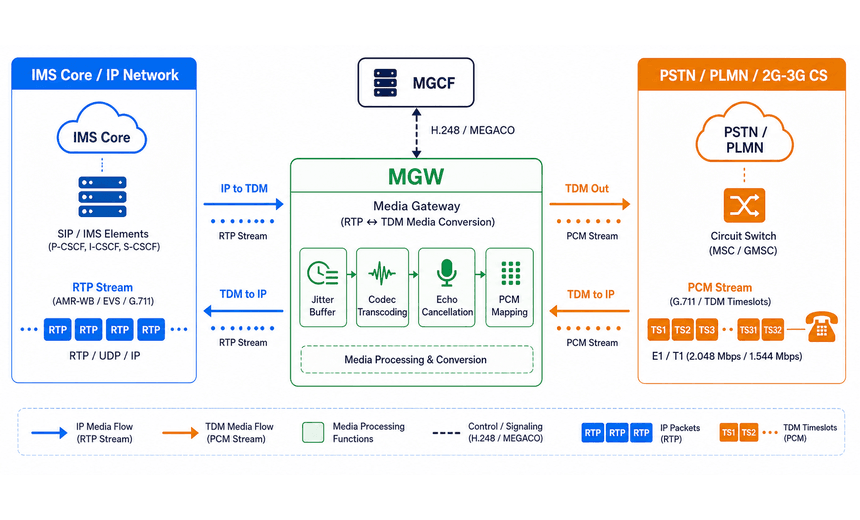
MGW receives the incoming RTP/UDP/IP voice stream from the IMS core. Adaptive jitter buffer absorbs packet arrival variation.
Voice payload is decoded from the source codec (e.g., AMR-WB) and transcoded to the destination codec (e.g., G.711). Echo cancellation is applied.
The processed PCM voice samples are mapped onto the designated E1/T1 timeslot and transmitted synchronously to the PSTN switch.
MGW terminates the incoming TDM circuit and extracts the synchronous PCM voice samples from the assigned timeslot.
PCM samples are encoded using the destination IP codec. Voice Activity Detection and Comfort Noise Generation optimize bandwidth during silence periods.
The encoded voice packets are transmitted as RTP/UDP/IP to the IMS core. RTP sequence numbers and timestamps ensure proper playback order at the receiving endpoint.
Voice Quality Assurance
ZBensoft MGW meets or exceeds every carrier voice quality benchmark — ensuring crystal-clear calls regardless of network type
MOS Score
Mean Opinion Score for transcoded calls — equivalent to direct G.711-to-G.711 quality. Listeners cannot distinguish between native and transcoded calls.
Echo Return Loss
Echo cancellation effectiveness measured against ITU-T G.168. Echo perceptibility eliminated even in worst-case hybrid scenarios at the TDM-IP boundary.
Packet Loss Concealment
Intelligent interpolation of lost voice frames. Listeners perceive uninterrupted speech even with up to 5% random packet loss in the IP network.
Transcoding Transparency
End-to-end codec negotiation success rate. Calls requiring multi-stage transcoding (e.g., EVS→AMR-WB→G.711) complete without perceptible quality loss.
Universal Codec Support
MGW supports every major voice and video codec deployed in global telecom networks — ensuring any call, any network, any device
Deployment Flexibility
ZBensoft MGW fits any network architecture — from traditional chassis-based to fully virtualized cloud-native media processing
Centralized Trunk Gateway
- High-density E1/T1/STM-1 termination
- Single chassis serves multiple MGCFs
- N+1 redundancy with hitless switchover
Distributed Edge Gateway
- Deploy at regional PSTN interconnect points
- Local media anchoring reduces backhaul
- Centralized H.248 control from MGCF
Virtualized vMGW
- VNF on OpenStack or CNF on Kubernetes
- Elastic DSP scaling with traffic demand
- Software-only — no proprietary hardware
Frequently Asked Questions
How does MGW differ from MGCF?
MGCF (Media Gateway Control Function) operates in the control/signaling plane — it converts SIP to ISUP and controls gateways via H.248. MGW (Media Gateway) operates in the media/user plane — it converts the actual voice/video streams between RTP (IP packets) and TDM (circuit-switched PCM). One MGCF can control many MGWs. This separation allows operators to scale signaling and media processing independently.
Can ZBensoft MGW work with third-party MGCF controllers?
Yes. ZBensoft MGW implements standard H.248/MEGACO protocol for control and standard RTP/RTCP for media transport. It interoperates with any 3GPP-compliant MGCF regardless of vendor. Operators can deploy our MGW under their existing MGCF, or deploy our MGCF to control their existing gateways — full flexibility.
What happens to voice quality during codec transcoding?
ZBensoft MGW maintains voice quality throughout transcoding via tandem-free operation where possible and intelligent transcoding where necessary. Our implementation achieves MOS scores within 0.1 points of direct same-codec calls — a difference imperceptible to the human ear. G.168 echo cancellation, adaptive jitter buffering, and packet loss concealment further ensure the end-user experience meets or exceeds native call quality.
Full-Stack Technology for Your Telecom Business
ZBensoft integrates charging, core network, and AI capabilities to help operators run efficiently and grow sustainably.
Request a Demo