Media Gateway Control Function
SIP-to-ISUP signaling gateway enabling seamless interconnection between IMS and legacy PSTN/PLMN networks.
The Two-World Interconnection Challenge
IMS and PSTN speak completely different languages. Without intelligent protocol translation, these two worlds cannot connect — leaving operators with costly workarounds and stranded subscribers.
VoLTE subscribers on IMS must reach 70% of global phone numbers still on PSTN and 2G/3G circuit-switched networks. Without interworking, every IMS-to-PSTN call simply fails.
Legacy PSTN switches only understand ISUP/BICC signaling over SS7. They have no concept of SIP, no IP connectivity, and cannot natively route calls into an IMS domain.
SIP sessions carry rich metadata — SDP codec offers, QoS parameters, emergency indicators. PSTN networks strip all of this. Without intelligent mapping, call quality degrades and emergency services break.
ISUP messages encode circuit identifiers (CICs), backward/forward call indicators, and cause codes that have no direct SIP equivalents. Blind protocol conversion loses critical routing and billing information.
IMS operators must manage dozens of PSTN interconnection agreements — each with different numbering plans, trunk groups, and rate tables. Manual routing configuration is error-prone and operationally expensive.
Each PSTN interconnect requires dedicated SS7 signaling links (F-links or A-links) to STPs. Maintaining separate signaling infrastructure for every partner adds hardware cost, complexity, and delays new interconnects.
Signaling Translation Engine
Six protocol domains, one unified translation platform — MGCF converts every signaling message with carrier-grade accuracy
SIP ↔ ISUP Interworking
Bidirectional mapping of every SIP request/response to the corresponding ISUP message. INVITE ↔ IAM, 180 Ringing ↔ ACM, 200 OK ↔ ANM, BYE ↔ REL — complete 3GPP TS 29.163 compliance for IMS-PSTN call control.
H.248 Gateway Control
Controls IP Multimedia Media Gateways (IM-MGW) via H.248/MEGACO. Dynamically creates, modifies, and deletes media contexts and terminations — instructing MGWs to open RTP ports, apply codecs, and manage echo cancellation.
SIP-I Encapsulation
Supports SIP-I (SIP with encapsulated ISUP) for networks that require transparent ISUP payload preservation. Carries complete ISUP messages inside SIP bodies, enabling ISUP feature transparency across IP transport networks.
SIGTRAN SS7 Transport
Native SIGTRAN support (M3UA, M2UA, M2PA) for SS7 signaling over IP. Connects directly to STPs and Signaling Gateways without legacy TDM hardware — pure IP signaling with full SS7 feature compatibility.
BICC Interworking
Supports Bearer Independent Call Control (BICC) for 3G CS core interworking. Converts BICC CS2 messages to SIP, enabling seamless call handover between 3G mobile networks and IMS.
Diameter Rf Charging
Generates standardized CDRs via Diameter Rf offline charging interface. Every interworked call — duration, source/destination, trunk group, routing decisions — is recorded for billing, reconciliation, and regulatory compliance.
Call Interworking in Action
Every IMS-to-PSTN call passes through MGCF — converting protocols, controlling gateways, and ensuring seamless media
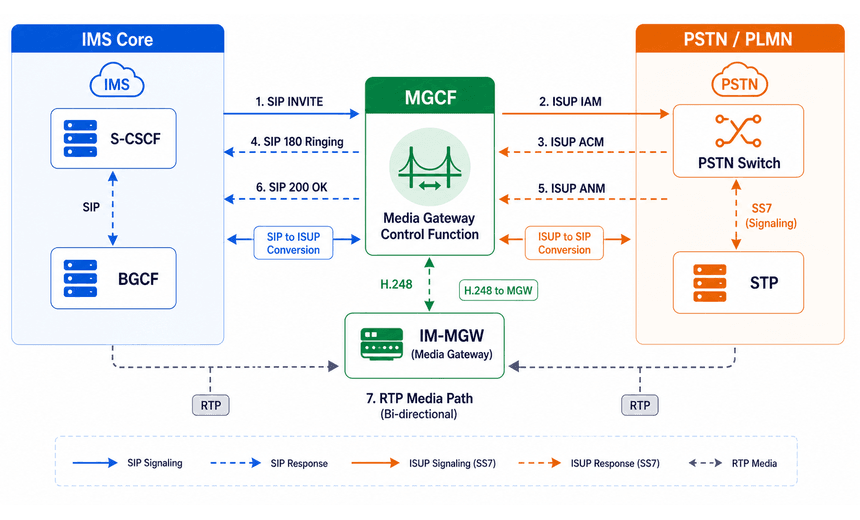
Call setup request. MGCF maps the SIP session description (SDP) to ISUP trunk parameters and circuit identification codes.
Alerting indication. ACM signals that the called party is being alerted — MGCF translates this to SIP 180 Ringing with optional early media.
Call answer. ANM triggers billing start. MGCF converts to SIP 200 OK and instructs the IM-MGW to establish the bidirectional RTP path.
Call release. MGCF maps the release cause code from ISUP to the appropriate SIP response, generates the final CDR, and tears down both sides.
Before and After MGCF
What changes when operators deploy a modern MGCF instead of relying on legacy interconnect workarounds
Without MGCF
- Separate trunk gateways for each PSTN partner — hardware sprawl, power, and real estate costs
- Manual SS7 link provisioning per interconnect — weeks of engineering effort, error-prone configuration
- No SIP-I support — ISUP information lost across IP transport, breaking supplementary services and billing
- Limited to 16-32 E1/T1 trunks per gateway — capacity constraints force over-provisioning at peak hours
With ZBensoft MGCF
- One software platform controls 100+ media gateways from any vendor — consolidate and simplify interconnect infrastructure
- SIGTRAN-based SS7 over IP — provision new signaling links in minutes, not weeks. All partner connections share the same IP network
- Full SIP-I transparency — preserve every ISUP parameter end-to-end, supporting all supplementary services, emergency calling, and number portability
- Elastic capacity up to millions of BHCA — scale software instances horizontally to match traffic, no hardware ceiling
Intelligent Call Routing
MGCF evaluates every call against configurable routing rules — ensuring each call takes the optimal path based on cost, quality, and regulatory requirements
Number Prefix Analysis
Match called party numbers against configurable prefix tables. Local calls stay local, long-distance routes to the appropriate national interconnect, international calls go to the cheapest qualifying carrier.
Time-of-Day Routing
Shift traffic between interconnect partners based on time-of-day rate schedules. Peak hours route to dedicated high-capacity trunks, off-peak leverages lower-cost wholesale agreements.
Blacklist & Whitelist
Block calls to premium-rate, fraudulent, or sanctioned number ranges before they reach the PSTN. Whitelist emergency numbers (110, 112, 911, 999) for unconditional priority routing.
Load Balancing & Failover
Distribute calls across multiple trunk groups and media gateways. If one gateway or signaling link fails, MGCF automatically redirects to backup routes — no dropped calls, no manual intervention.
Deployment Scenarios
ZBensoft MGCF adapts to any operator architecture — from legacy TDM interconnect to fully virtualized cloud-native deployments
Centralized National Interconnect
IPX & International Carrier
Cloud-Native vMGCF
Frequently Asked Questions
What is the difference between MGCF and BGCF?
BGCF (Breakout Gateway Control Function) is a routing function — it decides WHICH MGCF should handle a call exiting the IMS domain. MGCF does the actual work — protocol conversion (SIP↔ISUP), media gateway control (H.248), and CDR generation. Together, BGCF selects the optimal gateway and MGCF executes the interworking.
Can MGCF work with media gateways from other vendors?
Yes. ZBensoft MGCF uses standard H.248/MEGACO protocol to control IM-MGWs. Any 3GPP-compliant media gateway — regardless of manufacturer — can be controlled by our MGCF. Operators can mix gateway vendors, consolidate legacy gateways under one MGCF, and avoid vendor lock-in.
Does MGCF support emergency call interworking?
Absolutely. MGCF preserves emergency session indicators across the SIP-ISUP boundary, ensures priority routing for emergency numbers (112, 911, 999, 110, 119, etc.), and maps location information between SIP headers and ISUP parameters where available. This is critical for regulatory compliance during the PSTN-to-IMS migration.
Full-Stack Technology for Your Telecom Business
ZBensoft integrates charging, core network, and AI capabilities to help operators run efficiently and grow sustainably.
Request a Demo