Carrier-Grade Voice Self-Service Platform
A proven, reliable Interactive Voice Response system that automates routine customer inquiries through DTMF keypad input and pre-recorded voice prompts — reducing call center costs, extending service to 24/7, and delivering consistent, error-free responses to millions of callers every day.
The proven workhorse of call center automation — handling routine inquiries through simple keypad navigation, 24 hours a day
Running a Call Center Without Voice Self-Service Is Unsustainable
Every routine inquiry that reaches a live agent — balance checks, order status, office hours — is money spent on work a machine can do. IVR has been the answer for decades.
A Proven Architecture, Refined Over Decades
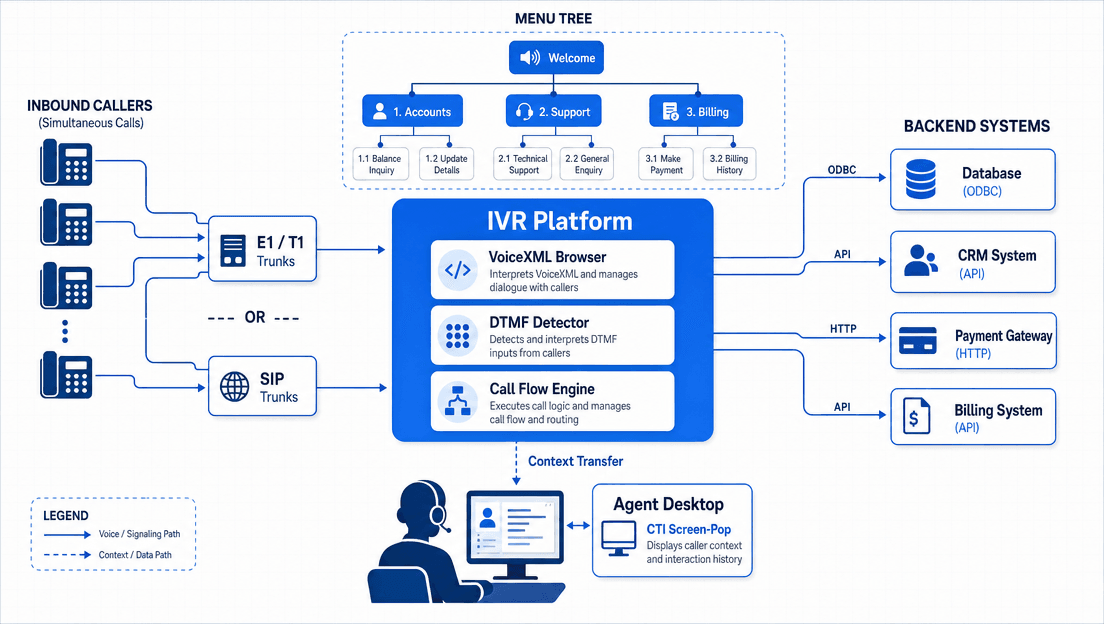
ZBensoft IVR follows the classic voice self-service model — phone lines in, menu navigation, backend queries, answers out
Call Handling & Queuing
E1/T1 or SIP trunk termination with automatic call distribution. IVR answers within two rings, plays the welcome prompt, and manages caller queuing — hold music, position announcements, estimated wait times. Every caller is acknowledged immediately, even at peak load.
DTMF Menu Navigation
Multi-level menu trees with up to 9 options per level. Callers press keys: "For account balance, press 1." The system validates input at every step and guides callers with clear, pre-recorded voice prompts. DTMF works on every phone ever manufactured — rotary, push-button, mobile, satellite.
Backend Data Integration
Real-time database queries, API calls, and legacy system access through standard connectors — ODBC, HTTP, TCP socket, file-based. IVR retrieves balances, posts payments, books appointments, and updates CRM records during the call — not in a batch job afterward.
Agent Transfer With Full Context
When callers need human help, IVR transfers to the right agent group with a CTI screen-pop showing the caller's full IVR path, entered data, and query results. The agent sees everything before answering — no "can you repeat your account number" required.
Where Voice Self-Service Delivers Immediate ROI
Any organization handling more than a few hundred calls per day. These are the deployments with the fastest payback.
Banking: Balance & Transactions
Account balance, last 5 transactions, cheque status, card activation, PIN change. These five inquiries represent 40-50% of all calls to a retail bank. One IVR installation handles every one of them — no agents, no wait times, no branch visits required.
Telecom: Usage & Account Management
Balance check, data usage inquiry, plan change, bill payment, fault report. Telecom operators worldwide use IVR as their frontline — 60-70% of incoming calls are fully resolved before reaching an agent queue. This is not theory; this is daily operations at every major carrier.
Government: Citizen Information Lines
Tax filing status, license renewal, permit applications, benefit eligibility, public health hotlines. When tax deadline day brings 100,000 calls, IVR is the only way to answer every one of them. A single IVR installation replaces 50+ full-time agents while extending service from office hours to 24/7.
Enterprise: Order & Account Self-Service
Order status, shipping tracking, warranty lookup, store locator, payment processing. For enterprises handling thousands of daily customer calls, IVR is the front door — resolving everything it can, routing the rest to the right person with complete context.
The Hard Numbers Behind Voice Self-Service
Decades of IVR deployment have produced clear, consistent metrics. These are not projections — they are what operators actually achieve.
Portion of total inbound calls fully resolved within IVR without reaching a live agent. Achieved through well-structured menus, clear prompts, and real-time backend data that answers the caller's actual question on the first attempt.
An IVR-handled call costs $0.05-0.15 versus $3-8 for a live agent call. At 1 million calls per month with 70% containment, that's $2-5 million in annual savings — before accounting for reduced hiring, training, and facilities.
IVR never calls in sick, never takes vacation, never has a bad day. Customers complete transactions at 3 AM on a public holiday with the same accuracy and response time as Tuesday at 10 AM — no shift premiums, no overtime.
When a caller presses "1" for balance, they expect an answer now — not after 30 seconds of hold music. ZBensoft IVR completes backend database queries and returns results in under a second, keeping caller frustration low and task completion rates high.
A Call Through IVR — Step by Step
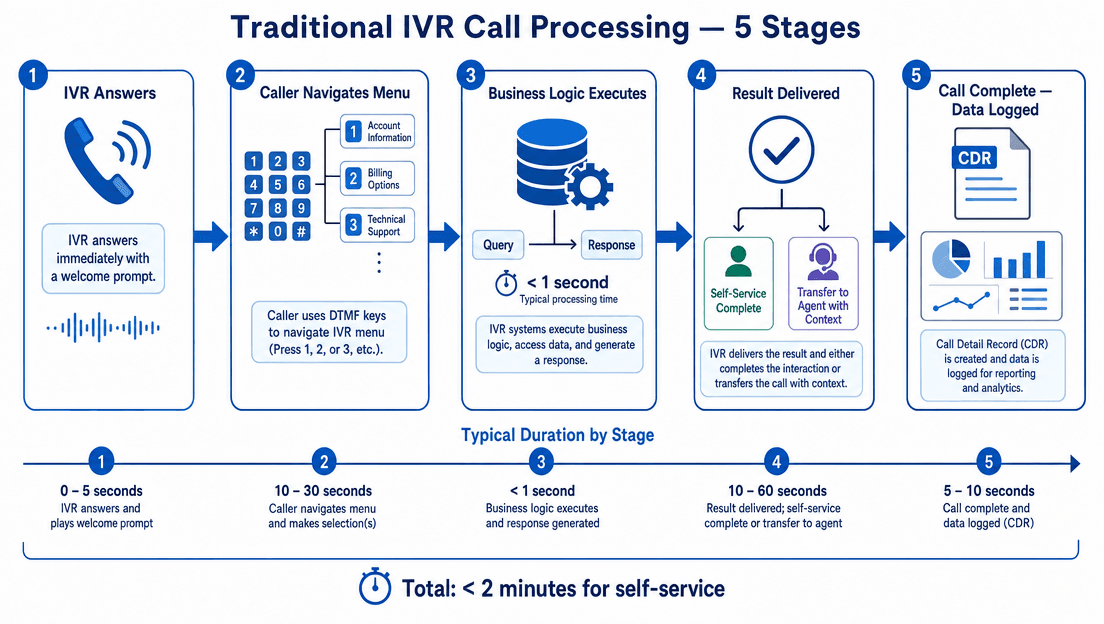
The classic voice self-service flow. Simple, reliable, repeated billions of times every day worldwide.
IVR Answers the Call
Inbound call arrives via PSTN E1/T1 or SIP trunk. IVR answers immediately — no ringing, no waiting. Caller hears the welcome greeting and first menu. ANI capture identifies the calling number for optional automatic account lookup.
Caller Navigates the Menu
Clear, concise prompts: "For account services, press 1. For technical support, press 2. For billing inquiries, press 3." The caller presses a key. The system validates the input, presents the next menu level, or proceeds to collect information for the transaction.
Business Logic Executes
Behind the prompts, the IVR runs real business logic. It queries account databases, checks payment status, validates transactions, updates records — all while the caller hears a brief "please wait" prompt. Results return in under a second.
Result Delivered to Caller
For self-service completions: IVR speaks the result ("Your current balance is 1,500 dollars") and offers next steps. For cases needing human help: IVR transfers to a skilled agent with a screen-pop showing the caller's entire IVR journey — no need to repeat anything.
Call Complete — Data Logged
Every call generates a complete record: caller number, menu path taken, transaction type, duration, outcome. Daily reports show containment rates per menu, drop-off hotspots, and hourly patterns — enabling continuous, data-driven menu refinement.
Who Depends on Traditional IVR Every Day
Voice self-service is not experimental technology. It has been battle-tested for decades by these organizations.
Banks & Credit Unions
Millions of monthly balance checks, transaction histories, card activations, loan payments. IVR is the most cost-effective channel in retail banking — and has been for over 30 years. It is not going anywhere.
Telecom Operators
Balance inquiries, usage checks, plan changes, bill payments, fault reports, service activation. Telecom IVRs handle more calls per day than most call centers handle in a month — proven at every major carrier worldwide since prepaid mobile first launched.
Government Service Hotlines
Tax status, permit applications, license renewal, benefit verification, public information. When 100,000 citizens call on tax deadline day, IVR answers every single one — something no human-staffed call center can do at any budget.
Enterprise Contact Centers
Order status, shipment tracking, warranty lookup, store locator, payment processing. For enterprises receiving thousands of daily calls, IVR is the first line — handling everything automatable, routing the rest to the right specialist with full context.
Frequently Asked Questions
Does ZBensoft IVR support both DTMF keypad input and speech recognition?
Yes. DTMF (telephone keypad) is the standard — it works on every phone ever made, from rotary desk phones to smartphones. Automatic Speech Recognition (ASR) is available as an optional module for menus where speaking is faster than pressing keys. Most deployments start with DTMF-only and add ASR later for specific high-volume menus — account numbers, for example, are faster spoken than keyed.
How many simultaneous calls can one IVR system handle?
ZBensoft IVR scales from 30 simultaneous calls on a single entry-level server to thousands of concurrent calls across distributed clusters. The system is designed for linear scaling — add E1 ports or SIP channels as volume grows. Production deployments at major operators routinely handle 5,000-10,000 concurrent calls on standard server hardware. For smaller deployments, even a single server reliably handles hundreds of simultaneous callers.
How long to deploy a basic IVR menu, and how hard is it to change later?
A basic single-level IVR menu with 4-5 options and pre-recorded prompts can go live in under a week. More complex multi-level menus with backend database integration typically deploy in 2-4 weeks. ZBensoft provides pre-built templates for banking, telecom, and government use cases. Once live, simple changes — adding a menu option, updating a prompt, changing a routing rule — take hours and can be applied without system downtime.
Full-Stack Technology for Your Telecom Business
ZBensoft integrates charging, core network, and AI capabilities to help operators run efficiently and grow sustainably.
Request a Demo