IP Multimedia Subsystem for VoLTE & VoWiFi
Full IMS Core network solution enabling HD voice (VoLTE), Wi-Fi calling (VoWiFi), video calling, and rich communication services over 4G and 5G networks.
Circuit Switching Has Reached End of Life
2G/3G voice networks dedicate a physical circuit to every call. Maintaining two separate networks (CS + PS) is unsustainable in cost and complexity for the data era
Double the networks, double the burden
Operators must maintain both a Circuit-Switched network for voice and a Packet-Switched network for data. Two sets of equipment, two operations teams, two scaling plans — operating costs doubled.
Voice experience frozen in time
Legacy CS voice offers only narrowband quality — 8kHz sampling, mono. When users are accustomed to HD video and HiFi music, traditional phone audio quality feels unacceptable.
New services require heroic effort
Launching video calling, conferencing, or rich communication on the CS network requires stacking complex IN platforms. Every new feature is a patchwork add-on — not architecture, just accumulated patches.
How IMS Carries Every Call
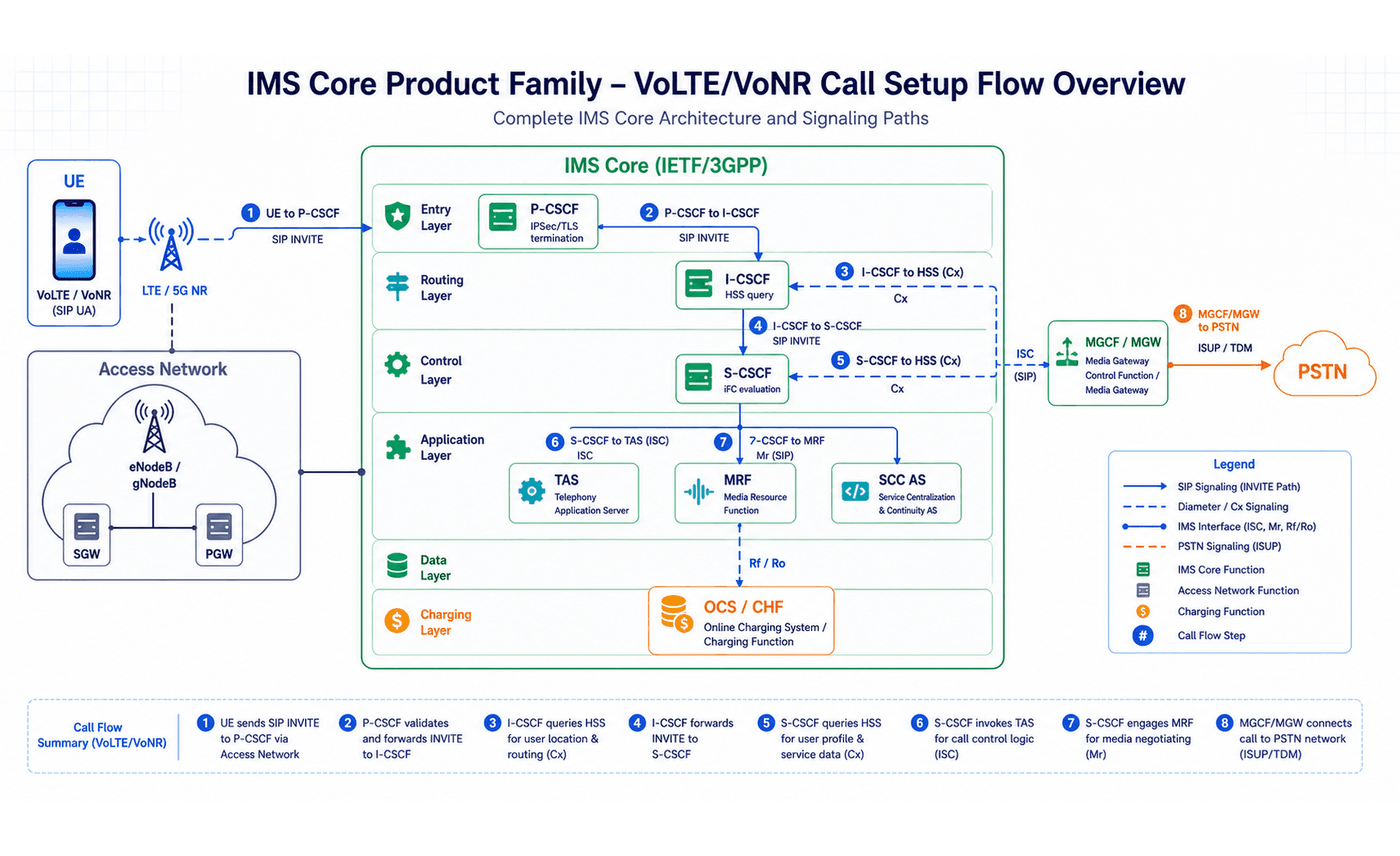
From dial to connect — IMS completes SIP signaling exchange in milliseconds, establishing end-to-end IP multimedia sessions
Registration
Phone powers on, sends SIP REGISTER via P-CSCF to the IMS network. I-CSCF queries HSS to locate the home S-CSCF. Registration complete, subscriber gets IMS service authorization.
Call Setup
Caller sends SIP INVITE. S-CSCF queries ENUM/DNS with the called number, routes the request to the called party's home network. Both S-CSCFs coordinate to establish the SIP session.
Media Negotiation
Both endpoints negotiate codec, bandwidth, and media type via SDP. MRF provides transcoding and conferencing bridges when needed. RTP media stream established after negotiation.
Call Maintenance
During the call, SBC handles NAT traversal and QoS. TAS provides hold, transfer, conferencing. P-CSCF continuously monitors session state and quality.
One Core, Six Capabilities
IMS is not a single element but a cluster of coordinated functions — each CSCF plays a distinct signaling role
The first point of contact for devices. Handles SIP registration, compression, and security. Ingress and egress for all UE signaling.
The network's border gateway. Queries HSS to assign the correct S-CSCF for each user. Hides internal network topology.
The brain of IMS. Performs registration, session control, routing, and service triggering — the central control point for the entire network.
The gatekeeper for network security and interworking. NAT traversal, DDoS protection, QoS marking, topology hiding.
Telephony Application Server. Provides call forwarding, conferencing, ringback tones, number translation, and other value-added services.
Media resource pool. Provides conferencing bridges, announcement playback, DTMF collection, and codec transcoding.
Circuit-Switched vs IP Multimedia
IMS is not a patch on CS networks — it is a fundamental architectural rebuild of voice communications
The Business Value of IMS
Operators unify all communication services on one IP network — cutting costs while unlocking new service revenue
Dramatic OpEx reduction
Decommissioning the CS network means operators maintain just one IP network. Equipment, power, site rental, and operations headcount all halved — directly improving profit margins.
HD Voice reduces churn
HD Voice dramatically improves call quality — clearer, lower noise. Subscribers perceive and appreciate the quality gap vs legacy. Reduced churn, improved brand reputation.
Telephony-as-a-Service revenue
IMS turns voice into a flexible IP-delivered service. Operators can offer cloud PBX, UCaaS, and API access to enterprises — upgrading voice from a commodity to a value-added revenue stream.
Who Needs IMS
Any operator wanting to deliver voice, video, and rich communication services over a single IP network
LTE & 5G Operators
Mobile operators deploying VoLTE and VoWiFi. IMS is the standard architecture for carrier-grade voice in the 4G/5G era — no IMS, no VoLTE.
Fixed-Line Operators
Migrating legacy PSTN to all-IP. IMS replaces TDM switches while preserving existing service experience — dramatically lower operating costs.
Enterprise UCaaS Providers
Delivering managed Unified Communications-as-a-Service. IMS provides the carrier-grade backend — SBC for secure access, TAS for rich telephony features.
Frequently Asked Questions
What is the relationship between IMS and VoLTE?
VoLTE is a service running on top of IMS. IMS provides the underlying SIP signaling and session management — VoLTE leverages these capabilities to deliver HD voice over 4G/5G networks. Without IMS, there is no VoLTE — just as without a GSM core there is no 2G calling.
Do subscribers need new phones for IMS?
The vast majority of modern smartphones (2015+) already have built-in IMS clients supporting VoLTE and VoWiFi. When operators deploy IMS, the network broadcasts VoLTE capability — phones auto-enable it. No new devices, no app installation required.
Can IMS serve both 4G and 5G simultaneously?
Yes. IMS is access-agnostic — whether a subscriber connects via 4G LTE, 5G NR, or WiFi, IMS provides the same SIP signaling and session management. The 5G-era IMS shares the same core architecture as 4G VoLTE, protecting operator network investments.
Full-Stack Technology for Your Telecom Business
ZBensoft integrates charging, core network, and AI capabilities to help operators run efficiently and grow sustainably.
Request a Demo