Interrogating Call Session Control Function
IMS routing function that queries HSS to locate the appropriate S-CSCF during registration and session setup.
Your Network Entry Cannot Be a Blind Spot
When an external SIP request arrives, the network must answer two questions: who is this user, and who serves them? I-CSCF is the gateway that answers both
External requests have no route
When SIP requests from other carriers or visited networks arrive at the network edge, no pre-configured routing table tells them where to go. If the entry gateway does not know who to ask, the request times out or is rejected.
Network topology exposure risk
If external requests can directly query the location and address of internal elements, attackers can easily map your network topology. Hiding internal structure is not optional — it is a security baseline.
Inter-carrier complexity
Different carriers use different IMS equipment and configurations. Incoming requests must be routed correctly without depending on the other network's details — standardized protocol-level interworking is essential.
How I-CSCF Works
Three steps to route external requests to internal services — each completed in milliseconds
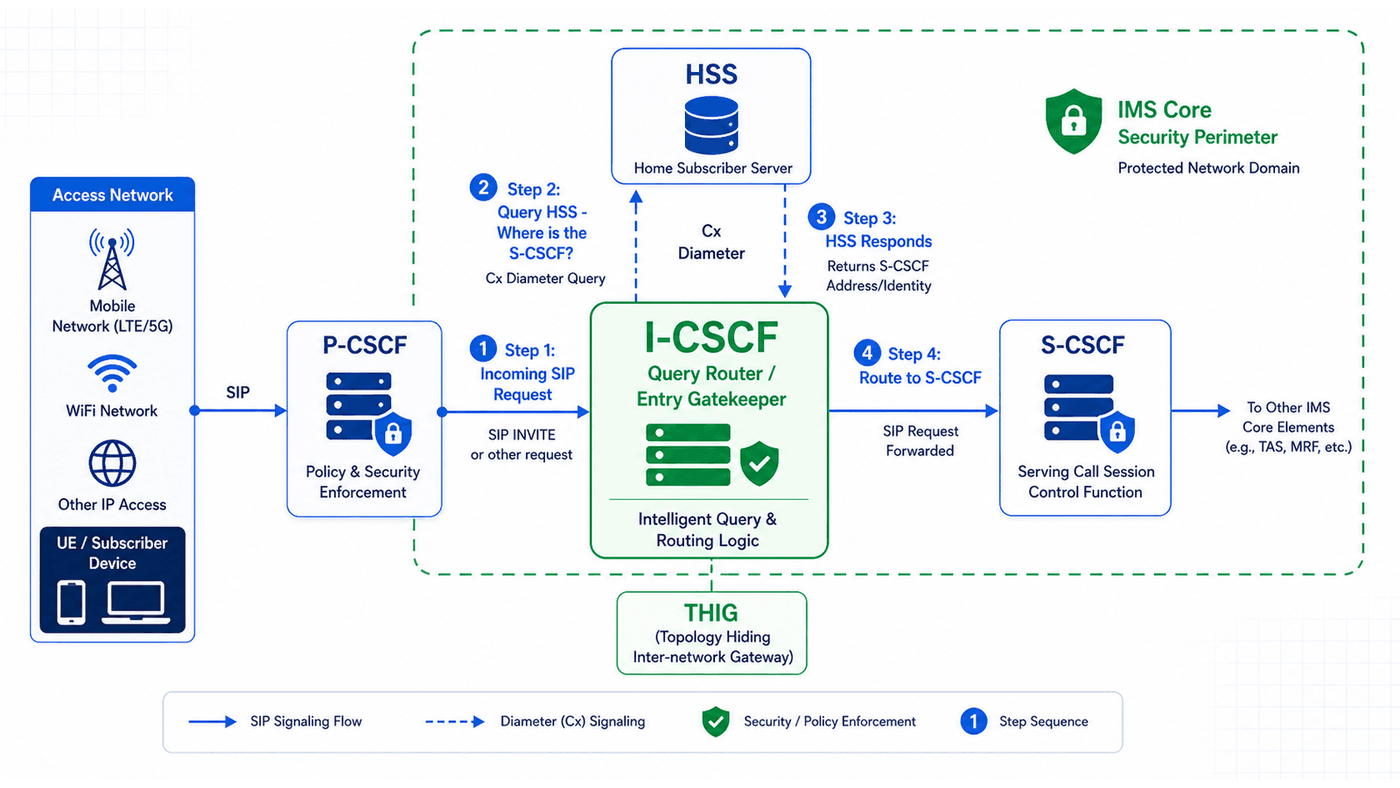
Receive external SIP request
A SIP INVITE or REGISTER arrives from another network or visited carrier. I-CSCF receives it at the network boundary, validates request format and origin.
Query HSS
I-CSCF queries HSS via the Cx Diameter interface — "Which S-CSCF serves this subscriber?" HSS returns the assigned S-CSCF address or capability set based on subscriber profile.
Forward to S-CSCF
I-CSCF forwards the SIP request to the S-CSCF address returned by HSS. All subsequent session signaling for this user is handled by the S-CSCF — I-CSCF's job is done.
With vs Without I-CSCF
The presence of I-CSCF determines whether your IMS is an open interconnected network or a closed island
The Operational Value of I-CSCF
I-CSCF may be understated in the IMS architecture — but it is the foundation of network security and interoperability
First line of network defense Security Gateway
I-CSCF is the only externally exposed entry point of the IMS network. Topology hiding, origin validation, protocol compliance checks — all security verification happens before requests enter the internal network.
Fully automated routing Automation
Zero static configuration — I-CSCF auto-discovers the correct S-CSCF via HSS query. Adding users, scaling S-CSCF pools — routing updates automatically, no manual adjustment.
Standards-based interop Interoperability
Built on the 3GPP-standard Cx interface — any compliant IMS network can interoperate with ZBensoft I-CSCF. Carrier interconnection transforms from an integration project to protocol alignment.
I-CSCF Core Capabilities
From S-CSCF assignment to topology hiding — I-CSCF is focused but every capability is essential
Dynamic S-CSCF assignment
Queries HSS via Cx Diameter to find the S-CSCF serving each subscriber. Supports load distribution — HSS can return different assignments based on S-CSCF capacity, enabling pooled load balancing.
Topology hiding
Hides the number, addresses, and capacity of internal S-CSCFs from external view. External requests only see I-CSCF — internal topology changes are transparent outside. A fundamental IMS security requirement.
SIP routing & forwarding
Accurately forwards SIP requests to the HSS-designated S-CSCF. Handles both registration and session requests — coordinates with P-CSCF to ensure reverse path integrity.
Protocol compliance
Validates format integrity of inbound SIP and Diameter requests. Rejects malformed and non-3GPP-compliant messages — security filtering at the entry point.
Who Needs I-CSCF
Any carrier that needs to interoperate with other IMS networks — I-CSCF is a mandatory component of the standard IMS architecture
IMS Carriers
Mobile and fixed-line operators deploying a full IMS core. I-CSCF is one of the three CSCFs defined in the 3GPP IMS standard — without it, external network interworking is impossible.
International Carriers
Operators needing SIP interworking with carriers in other countries or regions. I-CSCF provides a standard cross-network access point — enabling protocol interoperability between different vendors' IMS equipment.
MVNO Service Providers
Virtual operators delivering IMS services over host networks. I-CSCF provides a secure, controlled network entry — ensuring safe SIP routing between the host network and the MVNO.
Frequently Asked Questions
How is I-CSCF different from S-CSCF?
I-CSCF is the "interrogating" role — it receives external requests at the network edge, queries HSS to find the correct S-CSCF, then forwards. S-CSCF is the "serving" role — it performs user registration, session control, and service triggering. I-CSCF only intervenes when requests enter the network; S-CSCF serves the subscriber throughout the entire session.
Do small IMS deployments need I-CSCF?
If your network never needs to interconnect with other IMS networks (pure closed environment), you can theoretically skip I-CSCF. But any commercial deployment requiring VoLTE roaming, cross-network SIP interworking, or standards compliance must include I-CSCF. ZBensoft offers a compact I-CSCF for small deployments — full functionality, minimal footprint.
Is I-CSCF a single point of failure?
ZBensoft I-CSCF supports multi-instance cluster deployment — a front-end load balancer distributes external requests across multiple I-CSCF instances running in parallel. HSS queries return multiple S-CSCF capability sets, providing inherent redundancy. Single instance failure does not impact network interworking — other instances take over automatically.
Full-Stack Technology for Your Telecom Business
ZBensoft integrates charging, core network, and AI capabilities to help operators run efficiently and grow sustainably.
Request a Demo