Home Subscriber Server
Central subscriber database supporting 4G LTE authentication, authorization, and profile management with Diameter protocol.
Fragmented Subscriber Data Is Draining Your Operations
When subscriber data is scattered across a dozen systems, authentication slows down, operations become complex, and scaling is painful
Data silos, fractured subscriber view
HLR for 2G/3G, HSS for 4G, UDM for 5G. The same subscriber exists in multiple databases with different profiles — which one is authoritative? Every query requires cross-system aggregation, driving up latency and error rates.
Auth latency degrades user experience
Each cross-system lookup adds tens of milliseconds to authentication. The pause after dialing, the login hang, the VoLTE call setup delay — all trace back to fragmented data at the core.
Rigid capacity, scaling takes months
Legacy subscriber databases are tied to hardware. Scaling means procuring new boxes, months of deployment, and late-night cutovers. You cannot respond elastically to subscriber growth or promotional spikes.
One Database, Every Subscriber on the Network
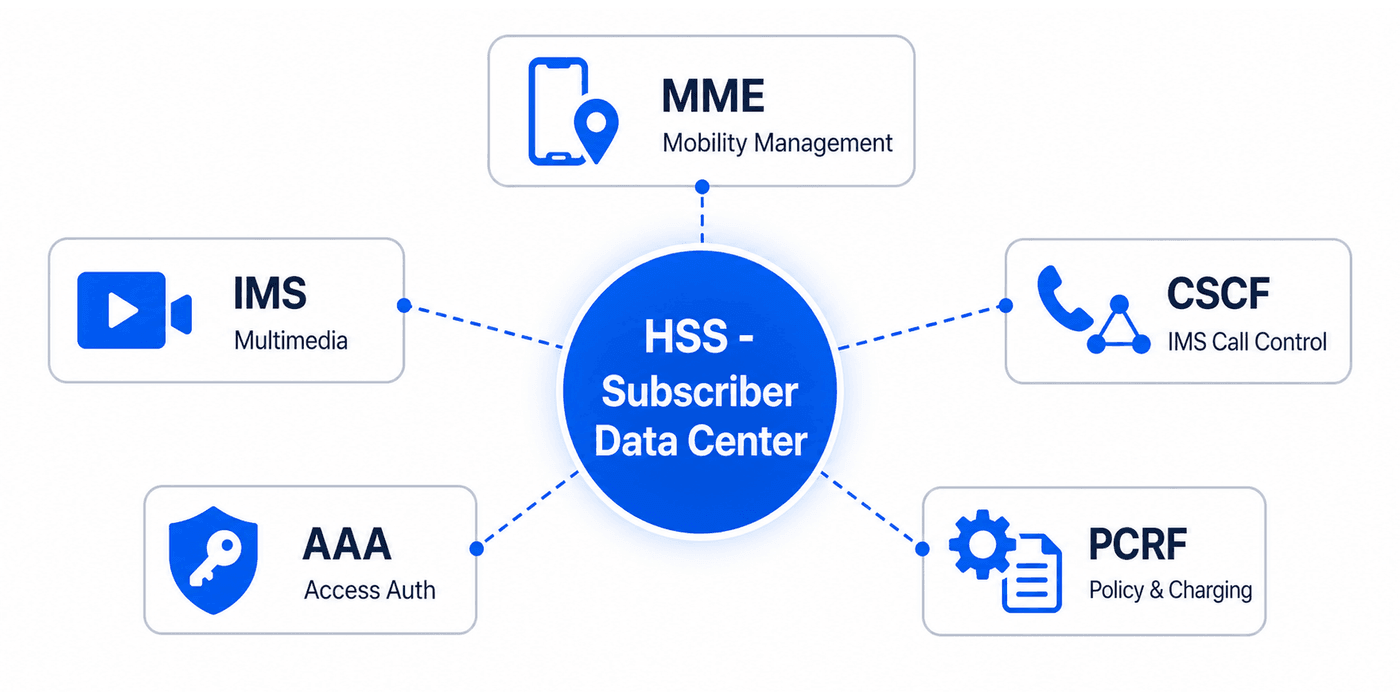
HSS is the single authoritative subscriber data source for 4G — MME, CSCF, PCRF, AAA, and IMS all depend on it for authentication, authorization, and service profiles
Unified vs. Fragmented
Traditional multi-database architecture vs. ZBensoft single source of truth — two fundamentally different operating models
Three separate databases (2G/3G HLR, 4G HSS, IMS-HSS), each maintaining its own subscriber copies
Single converged HSS serving 2G/3G/4G/IMS simultaneously — one subscriber record shared across the entire network
Cross-system data sync relies on batch scripts — information lags by hours or even days
Real-time reads and writes. Every network function always sees the latest subscriber state.
Each system scales independently. Low resource utilization. Operations teams must master multiple tech stacks.
Unified platform management. Elastic scaling on demand. One operations framework for all subscriber data.
What Unified Subscriber Data Actually Means
The real business, financial, and operational returns of a converged HSS platform
Zero-Downtime Subscriber Services
Active-active redundant architecture ensures subscriber data is always available. If a single node fails, queries automatically switch to the standby — subscribers notice nothing. Operators maintain brand reputation and avoid millions in outage-related revenue loss.
Sub-Millisecond Auth Response
Memory-optimized subscriber lookup engine completes authentication queries in under a millisecond. When subscribers place VoLTE calls or open data sessions, they experience zero perceptible delay — instant-on, every time.
Unified Operations, Controlled Costs
One system replaces multiple independent databases, reducing hardware footprint, power consumption, and operational headcount. Scaling shrinks from months to days, supporting promotions and traffic surges.
Four Layers of HSS Capability
From core to edge — each layer provides indispensable data services to the network
Authentication & Security
Stores authentication keys and executes AKA procedures. Every network attach, every VoLTE call — HSS verifies subscriber identity in the background. The foundation of network security.
Profile Management
Maintains each subscriber's service subscription data: plan type, QoS class, roaming permissions, APN configuration. Every network function queries HSS to determine how to serve that subscriber.
Location & Status Tracking
Tracks each subscriber's current serving cell and MME in real time. When a call or SMS arrives, the network locates the subscriber via HSS — the prerequisite for all mobile communication services.
Roaming & Interworking
Stores roaming agreements and visited-network policies. When a subscriber travels abroad, the visited network queries the home HSS via Diameter — one lookup, service activated instantly.
Who Needs HSS
Any operator running a 4G LTE network with mobile services — HSS is a mandatory component
4G LTE Operators
Mobile operators building or expanding LTE networks. HSS is a standard EPC component, managing identity and service data for tens of thousands to tens of millions of subscribers.
VoLTE Service Providers
Operators delivering HD voice services. IMS-HSS stores VoLTE service subscriptions, enabling CSCF to query subscriber capabilities and routing during call setup.
MVNOs
Virtual operators offering branded services over host networks. HSS manages MVNO subscriber identity and service policies, with Diameter interworking to the host network.
NB-IoT / LTE-M Operators
Managed service providers connecting massive IoT device fleets. HSS stores device identity, access policies, and service restrictions — every sensor needs a digital identity card.
Frequently Asked Questions
What's the difference between HSS and HLR?
HLR is the subscriber database for 2G/3G, HSS for 4G LTE. HSS is backward-compatible with HLR functions while adding Diameter protocol support (replacing SS7), richer subscriber profiles, IMS service subscriptions, and interfaces to all EPC elements. ZBensoft HSS is a converged platform — one system handling both HLR and HSS roles.
Do I need both HSS and UDM?
In pure 4G networks, only HSS is needed. During 4G/5G NSA transition, HSS continues serving 4G subscribers. When operators deploy 5G SA, ZBensoft provides a smooth upgrade path from HSS to UDM+AUSF — automated data migration with zero service interruption.
How many subscribers can a single HSS support?
ZBensoft HSS scales from compact deployments supporting tens of thousands of subscribers to carrier-grade distributed clusters handling tens of millions. The modular software architecture allows starting small and scaling horizontally on demand — no hardware replacement, no architecture rebuild.
Full-Stack Technology for Your Telecom Business
ZBensoft integrates charging, core network, and AI capabilities to help operators run efficiently and grow sustainably.
Request a Demo