Cell Broadcast Entity — Emergency Alert Command Center
The central management platform for national public warning systems — enabling authorized government agencies to compose, geo-target, schedule, and trigger emergency alerts that protect millions of citizens through CBC-based cell broadcast delivery.
The command center where emergency alerts are born — compose, target, schedule, and trigger warnings that save lives
Emergency Alert Management Should Not Be an Afterthought
When a tsunami is approaching or a chemical plant is burning, the difference between a well-executed alert and a chaotic response is measured in lives. Without a purpose-built CBE, emergency operators piece together alerts using generic tools never designed for life-or-death communications.
Generic Tools Cannot Handle Life-Critical Alerts
Emergency operations centers often compose alerts in word processors, send them via email for approval, then manually forward to telecom operators for broadcast. This ad-hoc chain introduces delays, errors, and single points of failure — unacceptable when minutes determine survival.
Geo-Targeting Without a Map Is Guesswork
Describing an evacuation zone in text — "coastal areas within 5 km of the shoreline between Town A and Town B" — leaves room for misinterpretation. CBE provides map-based area selection where operators draw polygons on a map, and the system translates them into precise cell-sector lists automatically.
Multi-Agency Coordination Breaks Without Workflows
Effective public warning involves multiple agencies: meteorological office detects the threat, civil protection decides to alert, police manage evacuation, media broadcast updates. Without built-in multi-agency workflows, coordination happens through phone calls and email chains — slow, error-prone, and impossible to audit.
No Audit Trail Means No Accountability
After every emergency, the questions come: Who authorized the alert? When was it sent? Why was this area included or excluded? Without comprehensive alert lifecycle logging, operators face regulatory investigations, legal liability, and public mistrust — all because the alert system lacked audit capability.
CBE — The Alert Command Center
ZBensoft CBE provides authorized agencies with everything they need to create, approve, and trigger emergency alerts — from map-based targeting to multi-language composition to full lifecycle tracking
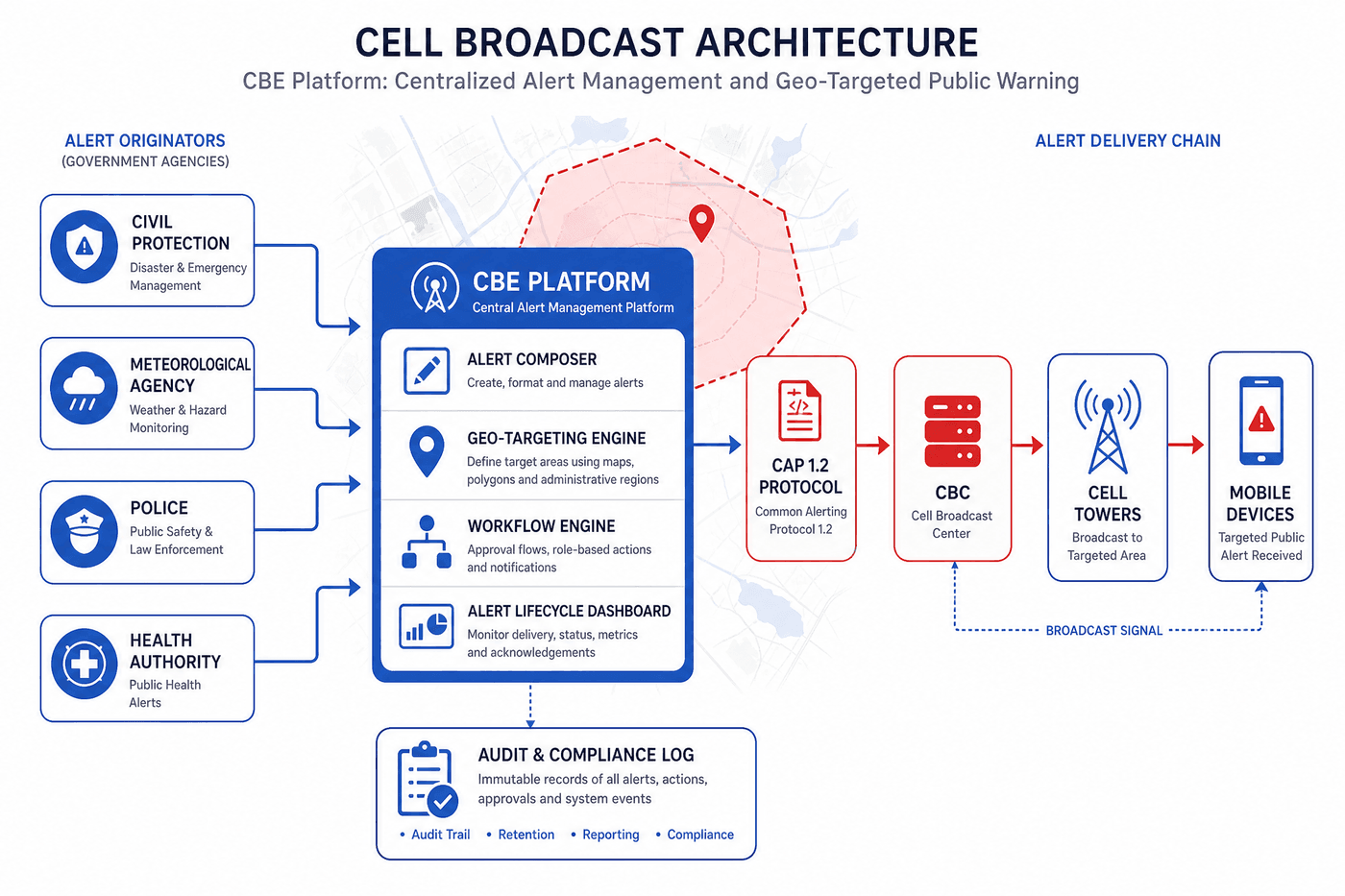
Alert Composer
A purpose-built interface for emergency operators to create alerts quickly under pressure. Select alert type from a pre-configured catalog (earthquake, tsunami, flood, fire, terrorist, chemical, amber alert). Compose messages in all required languages with automatic translation templates. Every field is designed to be completed in under 60 seconds.
Map-Based Geo-Targeting
Operators draw the alert area directly on a map using polygon, circle, or administrative boundary selection tools. The CBE translates the geographic selection into network topology coordinates — cell sectors, location areas, tracking areas — that the CBC uses for precise broadcast targeting. Visual confirmation eliminates geo-targeting errors.
Multi-Agency Workflow Engine
Configurable approval chains route alerts through the correct agencies before broadcast. A meteorological warning requires meteorology office composition → civil protection approval → operator broadcast. Each step is tracked with timestamp, user ID, and digital signature. Emergency overrides allow authorized users to bypass approval for immediate-threat scenarios.
Alert Lifecycle Dashboard
Real-time tracking of every alert from creation through broadcast and public acknowledgement. Operators see delivery status by cell sector, message repetition counts, and all-clear issuance status. Post-event reports provide complete audit trails for regulatory compliance and continuous improvement.
The CBE Difference — Speed, Precision, Accountability
The CBE is the human interface of the public warning system. These are the metrics that define its effectiveness.
From login to broadcast trigger — a trained operator can compose, target, and send an emergency alert in under one minute. Pre-configured alert templates, map favorites for high-risk zones, and multi-language auto-translation eliminate every unnecessary second.
Every action is logged: who logged in, which alert template was selected, what area was targeted, who approved, when it was sent, when CBC confirmed delivery. This complete chain of custody satisfies the most stringent regulatory requirements and provides legal protection for all participating agencies.
Map-drawn polygons are automatically translated into individual cell sector lists — typically 500m to 5km radius depending on network density. Operators see exactly which areas will receive the alert before pressing send. No text descriptions, no ambiguity, no missed coverage.
The multi-agency workflow engine supports unlimited participating organizations — meteorological, civil protection, police, fire, military, health ministry, transportation authority. Each with configurable roles, permissions, and approval authorities. One platform coordinates the entire national emergency response ecosystem.
An Emergency Alert — From Detection to Delivery
The CBE is where human judgment meets technological precision. This is the alert lifecycle that saves lives.
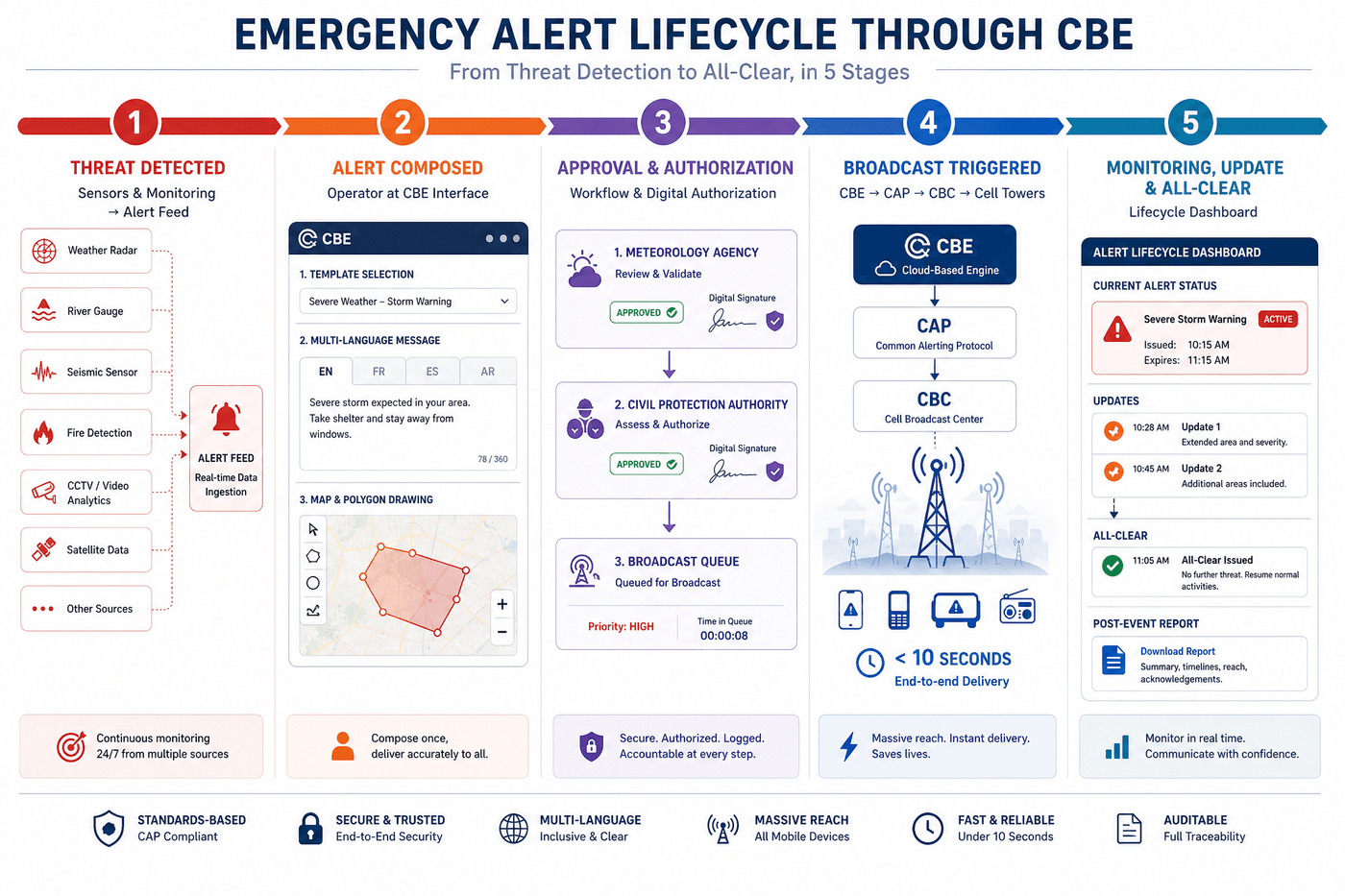
Threat Detected
A monitoring system or trained observer identifies an imminent threat — seismic sensors detect an earthquake, weather radar shows a forming tsunami, a chemical plant alarm triggers. The information reaches the emergency operations center through integrated data feeds or direct hotline.
Alert Composed
An authorized operator logs into CBE and selects the appropriate alert template. They compose the warning message in all required languages, draw the affected area on the map, set the urgency level and repetition schedule, and attach any additional information — evacuation routes, shelter locations, emergency numbers.
Approval & Authorization
The alert follows the configured approval chain. For a tsunami warning, the meteorology office composes, civil protection approves, and the alert is queued for broadcast. Each approval step is digitally signed and logged. For immediate-threat scenarios, a single authorized official can trigger directly.
Broadcast Triggered
CBE sends the alert to CBC via the CAP 1.2 protocol interface. The CBC receives the message, geographic target, and broadcast parameters. Within seconds, the CBC begins broadcasting to the target cell sectors. CBE monitors delivery status in real time — operators see green when all sectors confirm broadcast.
Monitoring, Update & All-Clear
CBE tracks the full alert lifecycle. Operators issue updates as the situation evolves — expanding or contracting the target area, updating instructions. When the danger passes, an all-clear message is sent through the same channels. Post-event reports with complete audit trails are generated for regulators, media, and public review.
Who Operates the CBE Command Center
Authorized government agencies and emergency services — the organizations responsible for protecting citizens when disaster strikes
National Civil Protection Agencies
The primary operators of CBE — responsible for all-hazard emergency warning. Integrate CBE with national disaster monitoring systems, operate 24/7 emergency operations centers, and coordinate multi-agency alert responses for earthquakes, floods, fires, and industrial accidents.
Meteorological & Seismic Agencies
Detect and characterize natural threats — earthquake magnitude and epicenter, tsunami propagation models, storm tracks and intensity. CBE receives automated data feeds from monitoring equipment and enables meteorologists to compose and pre-approve weather-related alerts.
Law Enforcement & Security Agencies
Issue public safety alerts for terrorist threats, active shooter situations, missing persons (Amber/Silver alerts), and civil unrest. CBE provides secure, audited alert workflows compatible with classified operational security requirements.
Public Health Authorities
Issue health emergency alerts for disease outbreaks, pandemics, contamination events, and vaccination campaigns. CBE supports health-specific alert templates and multi-language messaging essential for reaching diverse populations.
Frequently Asked Questions
What is the relationship between CBE and CBC?
CBE (Cell Broadcast Entity) is the alert creation and management platform used by government agencies — it is where alerts are composed, targeted, and triggered. CBC (Cell Broadcast Center) is the network delivery function operated by mobile operators — it receives alerts from CBE via the CAP protocol and broadcasts them through cell towers to mobile devices. Think of CBE as the command center interface and CBC as the broadcast engine. ZBensoft provides both as an integrated solution, with CBE deployed at government operations centers and CBC deployed in operator networks.
Can multiple agencies use the same CBE platform simultaneously?
Yes. ZBensoft CBE supports unlimited concurrent users across unlimited agencies with role-based access control. A meteorological agency can compose weather alerts, a police agency can issue public safety alerts, and a health authority can trigger vaccination campaign notifications — all on the same platform with complete data isolation between agencies. Configurable workflows ensure each agency follows its own approval chain, and the audit trail records which agency initiated every alert.
How does CBE ensure alerts are not sent accidentally?
ZBensoft CBE implements multiple safeguards: multi-factor authentication for all operators, configurable multi-step approval workflows (no single person can trigger alone unless authorized), a confirmation dialog that displays the full alert content, target area map, and affected population estimate before final send, and a 10-second abort window after triggering that allows operators to cancel before broadcast begins. All alerts — including those aborted — are permanently logged for audit.
Full-Stack Technology for Your Telecom Business
ZBensoft integrates charging, core network, and AI capabilities to help operators run efficiently and grow sustainably.
Request a Demo