Cell Broadcast Center for Public Warning
A 3GPP-compliant Cell Broadcast Center that delivers geo-targeted emergency alerts to every mobile device in a defined area within seconds — enabling national public warning systems for natural disasters, terrorist threats, and public health emergencies across 2G, 3G, 4G, and 5G networks.
When seconds save lives — broadcasting emergency alerts to every mobile device in a defined area, instantly
Without Cell Broadcast, Emergency Alerts Never Reach Everyone
SMS-based emergency alerts cannot scale to millions of recipients in seconds. They queue, they delay, they fail when networks are congested. Cell Broadcast reaches every device in a target area simultaneously — the technology that saved countless lives during earthquakes, tsunamis, and wildfires worldwide.
SMS Cannot Deliver Emergency Alerts at Scale
Sending an SMS to 10 million people takes hours — the SMSC queues messages and delivers them one by one. During a tsunami warning, you have minutes, not hours. Cell Broadcast delivers the alert to every device in the target area simultaneously, regardless of network load.
Network Congestion During Disasters Blocks Alerts
When disaster strikes, everyone tries to call or text simultaneously. Networks congest. SMS queues overflow. The alert that was supposed to warn people gets stuck behind "Are you okay?" messages. Cell Broadcast uses a dedicated signaling channel that does not compete with voice and data traffic.
Geo-Targeting Is Impossible With Generic Alert Systems
A flood warning matters to people in the flood zone — not to people 200 km away. SMS-based alerts blast everyone or no one. Cell Broadcast targets alerts down to individual cell sectors — warning only the people who actually need to evacuate, without causing panic elsewhere.
Regulatory Mandates Require Cell Broadcast
The EU mandate (EECC Article 110) requires all member states to deploy cell broadcast-based public warning systems. Similar mandates exist or are emerging in the Middle East, Asia-Pacific, and Latin America. Non-compliance means regulatory penalties, legal liability, and — most critically — unprotected citizens during emergencies.
How Cell Broadcast Works — Simple, Reliable, Proven
ZBensoft CBC sends emergency alerts through the existing mobile network infrastructure — no apps, no subscriptions, no databases of phone numbers required
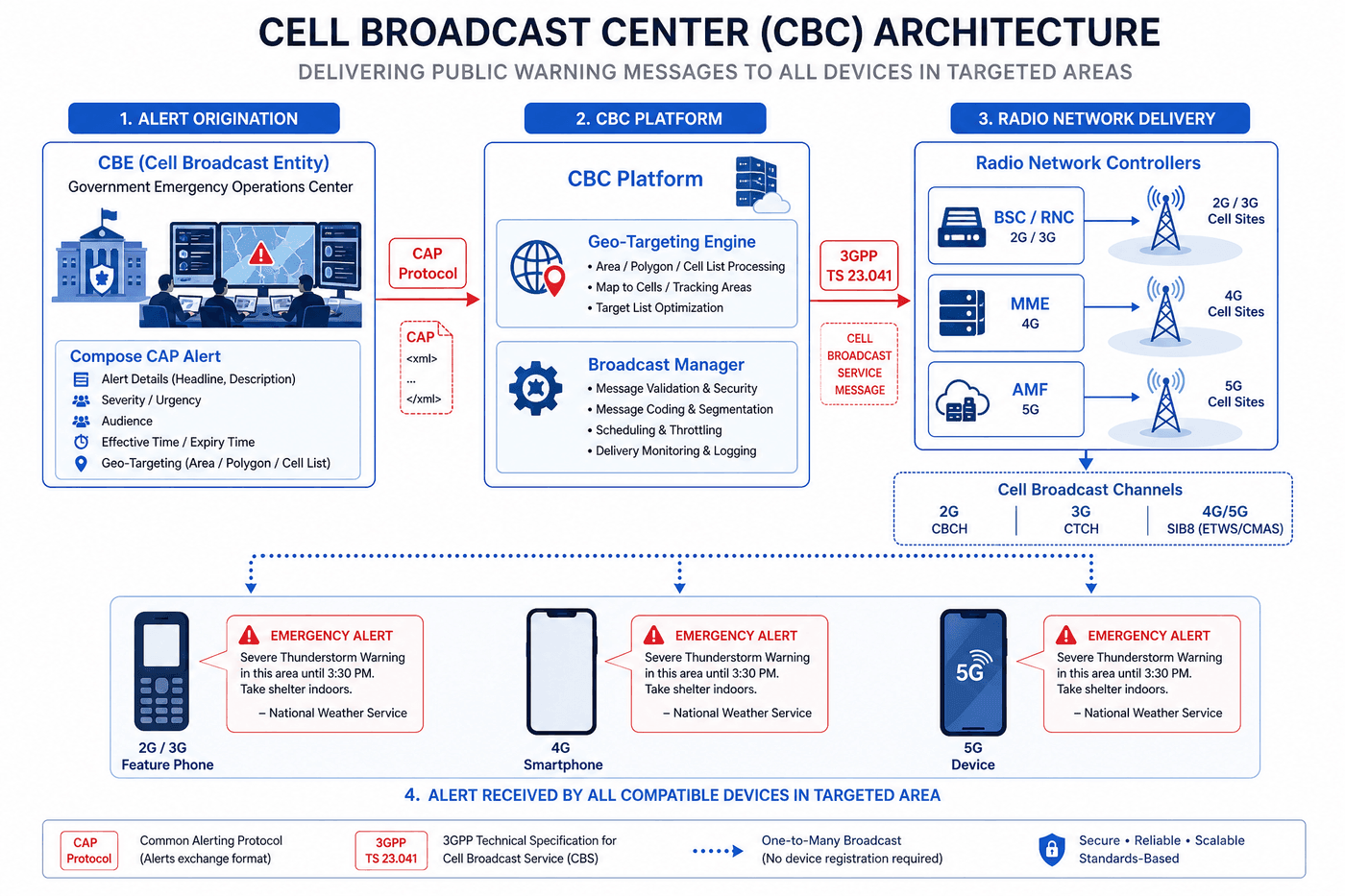
Alert Origination (CBE)
Authorized government agencies compose emergency alerts through the Cell Broadcast Entity (CBE) interface using Common Alerting Protocol (CAP). Alerts include the warning message, affected geographic area, urgency level, and recommended protective action.
Geo-Targeting & Broadcast Planning
The CBC translates the geographic target area into a list of cell sectors using network topology data. Only cells covering the affected area are selected — ensuring alerts reach people who need to act, not those safely outside the danger zone.
Simultaneous Broadcast
The CBC pushes the alert to the selected cells via the radio network (BSC/RNC for 2G/3G, MME for 4G, AMF for 5G). Every device in those cells receives the alert simultaneously through the cell broadcast channel — no queuing, no congestion, no delay.
Multi-Language & Repetition
Alerts are transmitted in all configured languages with automatic repetition at defined intervals. Devices display the alert in the user's preferred language. Repetition ensures late-entering devices — someone driving into the affected area — receive the warning.
Cell Broadcast Performance — Measured in Lives, Not Just Metrics
When an earthquake hits or a tsunami approaches, these are the numbers that determine how many people receive the warning in time.
From the moment an authorized official presses "send" to the moment every device in the target area displays the alert — less than ten seconds. No queuing, no batching, no SMS delivery pipeline. Simultaneous broadcast to all devices.
Cell Broadcast works on every mobile phone — 2G feature phones, 4G smartphones, 5G devices, roaming visitors. No app installation required, no opt-in needed, no phone number database to maintain. If the device is powered on and in the target area, it receives the alert.
Cell Broadcast uses dedicated signaling channels (CBCH on 2G, CTCH on 3G/4G, SIB8 on 5G) that are completely separate from voice and data traffic. Even when the network is 100% congested with emergency calls, the alert still gets through.
Alerts can be targeted to individual cell sectors — typically 500m to 5km radius depending on network density. A chemical plant evacuation targets only the surrounding industrial zone. A stadium emergency targets only the venue and access roads. Precision targeting prevents panic.
An Emergency Alert — From Decision to Delivery
When every second counts, this is the path an alert takes from the operations center to millions of devices
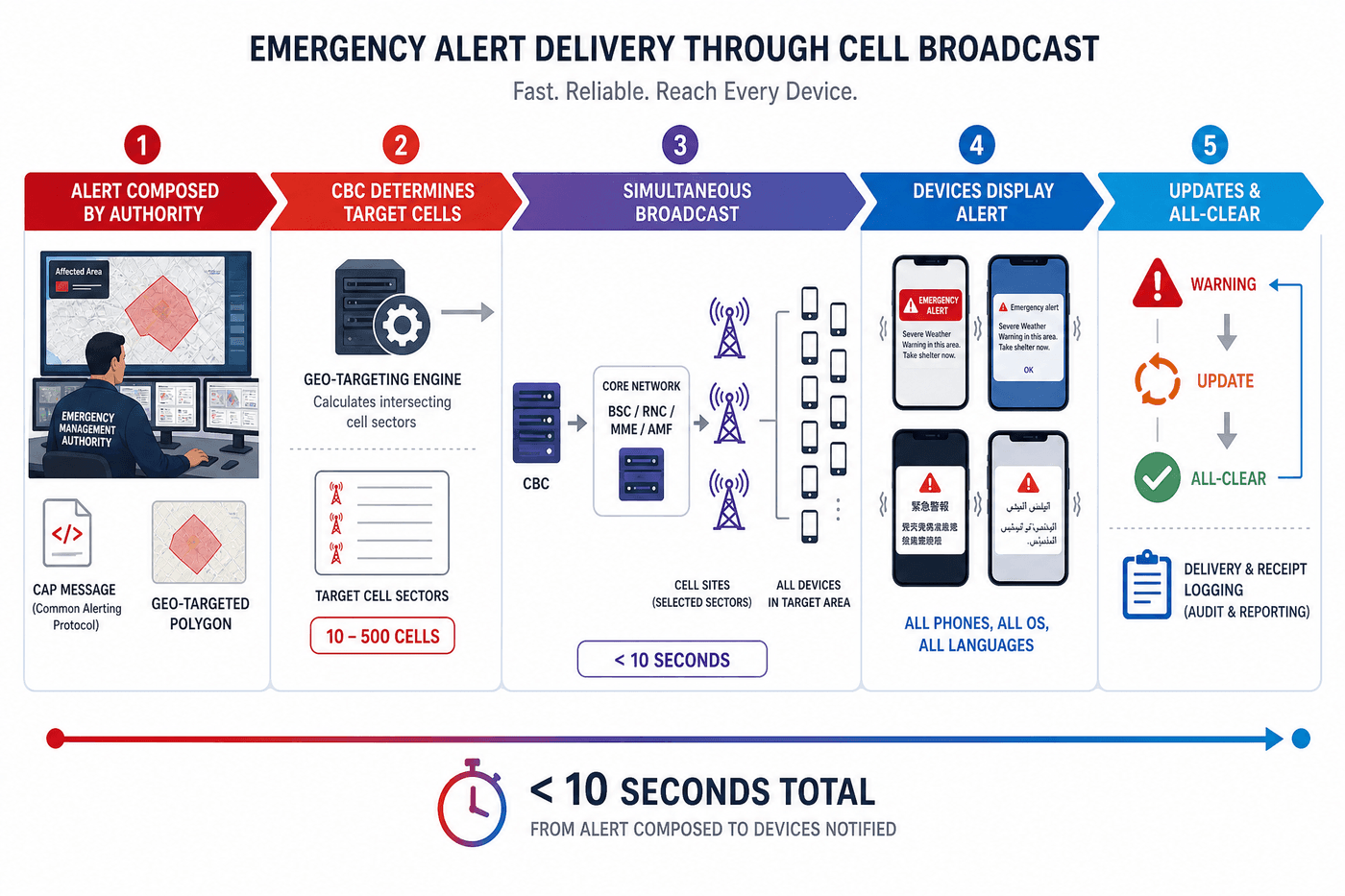
Alert Composed by Authority
An authorized official at a national emergency operations center or meteorological agency composes the alert using the CBE interface. They select the alert type (earthquake, tsunami, flood, fire, etc.), compose the warning message, draw the affected area on a map, and press send.
CBC Determines Target Cells
The CBC receives the CAP message with geographic coordinates. It queries the network topology database and translates the polygon on the map into a precise list of cell sectors — typically 10 to 500 cells depending on the size of the affected area.
Simultaneous Broadcast to All Devices
The CBC pushes the alert to the radio network controllers (BSC, RNC, MME, AMF) serving the target cells. Within seconds, the controllers begin broadcasting the alert on the cell broadcast channel. Every device in those cells receives the identical message at the same instant.
Devices Display the Alert
Every mobile device in the target cells — regardless of make, model, OS, or whether it belongs to a resident, visitor, or roamer — displays the alert. The phone may vibrate, play a distinct warning tone, and show the message in the user's language. This happens even if the phone is on silent.
Ongoing Updates & All-Clear
The CBC supports the full alert lifecycle: initial warning, updates as the situation evolves, and an all-clear message when the danger has passed. Each message can expand, contract, or shift the target area. All alerts are logged for compliance, auditing, and post-event analysis.
Who Deploys Cell Broadcast Public Warning Systems
National governments, regulatory agencies, and mobile operators — working together to protect citizens
National Governments & Civil Protection
Operate the CBE to compose and issue emergency alerts. Integrate CBC with national disaster management systems, meteorological agencies, and first responder networks. The government owns the alerting authority; the operator provides the delivery infrastructure.
Mobile Network Operators
Deploy CBC as a regulatory-mandated network function. Enable cell broadcast channels across the radio access network and integrate CBC with existing OSS and network management systems. Meet EU EECC Article 110 and similar mandates.
Telecom Regulatory Authorities
Define national public warning system standards, mandate CBC deployment timelines, and oversee compliance testing. Ensure interoperability between government CBE systems and operator CBC platforms through standardized CAP interfaces.
Disaster Management Agencies
Use CBC as the primary channel for emergency public communication. Integrate cell broadcast alerts with siren systems, emergency broadcast media, and first responder dispatch — creating a unified, multi-channel public warning strategy.
Frequently Asked Questions
How is Cell Broadcast different from SMS-based emergency alerts?
SMS sends messages one-by-one to each phone number in a database — it takes hours to reach millions and fails when networks are congested. Cell Broadcast sends one message that every device in a target area receives simultaneously through a dedicated signaling channel — it takes seconds, requires no phone number database, and works even when voice and data networks are completely congested. This is why the EU mandates Cell Broadcast (not SMS) for public warning under EECC Article 110.
Do subscribers need to install an app or opt in to receive alerts?
No. Cell Broadcast is a network-level feature that works on every mobile phone by default — no app installation, no opt-in, no registration required. The alert is delivered through a standard 3GPP signaling channel that all phones support. Devices manufactured since 2007 (2G), 2010 (3G), and 2014 (4G/5G) include native Cell Broadcast support. Most regulators also mandate that users cannot opt out of presidential or life-threatening alerts.
How long does it take to deploy a national CBC system?
ZBensoft CBC can be deployed and integrated with an existing mobile network in 3-6 months. The deployment includes CBC software installation, CBE interface configuration for government users, radio network cell broadcast channel activation, and end-to-end testing with all device types in the market. Multi-operator national deployments typically take 6-12 months including inter-operator coordination, regulatory certification, and public awareness campaigns. ZBensoft provides turnkey deployment services including integration with existing government CBE platforms.
Full-Stack Technology for Your Telecom Business
ZBensoft integrates charging, core network, and AI capabilities to help operators run efficiently and grow sustainably.
Request a Demo