Intelligent IMS-to-PSTN Breakout Routing
A carrier-grade Breakout Gateway Control Function that intelligently routes voice calls from IMS networks to the PSTN/CS domain — selecting the optimal media gateway, managing inter-operator routing, and ensuring seamless voice interconnection between next-generation and legacy networks.
The intelligent routing bridge between IP voice and the global telephone network
IMS-PSTN Interworking Shouldn't Be This Hard
Every IMS call to a PSTN number must find the right path out of the IP network. Manual routing, rigid configurations, and vendor lock-in make it harder than it should be.
Manual Routing Configuration
Traditional gateways require static route tables maintained by network engineers. Every new interconnect partner, every number range change, every route optimization means weeks of manual configuration and testing — slowing time-to-market for new voice services.
Limited Inter-Operator Flexibility
Legacy PSTN gateways offer minimal inter-operator routing intelligence. When the optimal breakout path crosses another operator's network, rigid routing rules force suboptimal paths — increasing interconnect costs and degrading call quality.
Vendor Lock-In at the Network Edge
Many MGCF solutions bundle routing control with media handling, locking operators into a single vendor for both signaling and media planes. Upgrading routing logic means replacing the entire gateway — a multi-year, multi-million-dollar migration.
Scaling Challenges with Legacy Gateways
Traditional PSTN gateways scale vertically on dedicated hardware. When traffic spikes — holiday calling peaks, emergency events, mass notifications — operators must over-provision capacity that sits idle 95% of the time, wasting capital and rack space.
BGCF at the IMS-PSTN Boundary
The Breakout Gateway Control Function sits at the critical junction between next-generation IP voice and the global circuit-switched telephone network
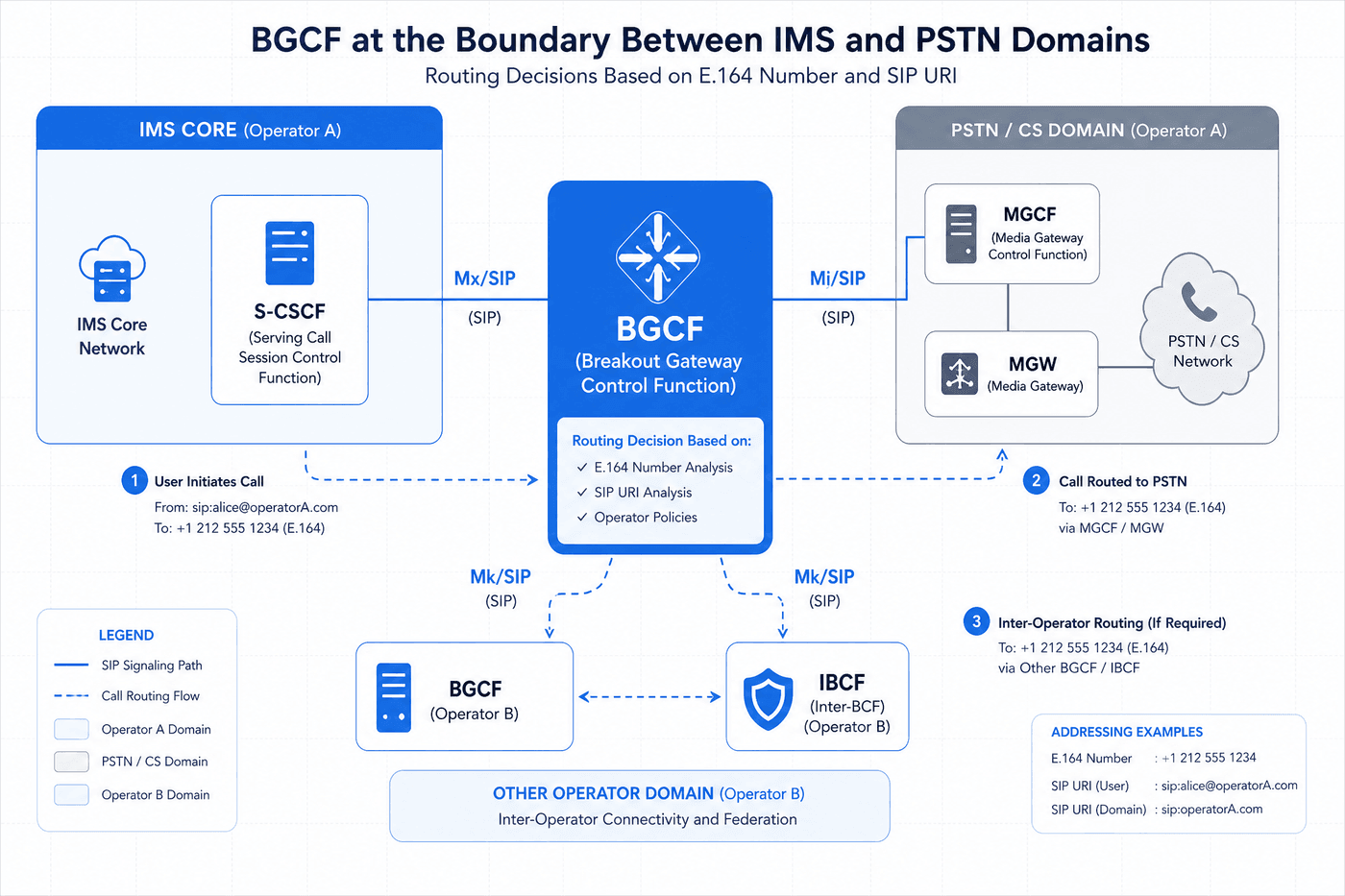
When the S-CSCF determines a call cannot be routed within IMS (PSTN/E.164 destination), it forwards the SIP INVITE to BGCF via the Mx reference point. BGCF becomes the routing decision point for all IMS-to-PSTN breakout.
BGCF selects the optimal MGCF within the same network based on called number analysis, local routing policy, and gateway availability. The selected MGCF handles SIP-to-ISUP/BICC signaling conversion and controls the MGW for media plane interworking.
When the breakout point is in another operator's network, BGCF forwards the SIP session to that network's BGCF via the Mk reference point. The remote BGCF then selects its own MGCF — enabling multi-operator voice interconnection without direct gateway access.
Intelligent Routing That Adapts in Real Time
ZBensoft BGCF brings software-defined routing intelligence to the IMS-PSTN boundary — separating control from media, enabling flexible policy, and scaling on demand
Software-Defined Routing
Decouple routing control from media handling. Change routing policies, add interconnect partners, and optimize breakout paths through software configuration — no hardware changes, no gateway replacements, no service downtime.
Multi-Layer Route Resolution
E.164 number analysis → ENUM/DNS query → local policy evaluation → route ranking. BGCF applies multiple resolution layers in sequence, ensuring every call takes the most cost-effective, highest-quality path available at that moment.
Carrier-Grade Elastic Scale
Cloud-native, stateless architecture scales horizontally. Handle predictable peak loads without over-provisioning. Each BGCF instance processes routing decisions independently — add capacity in seconds during unexpected traffic surges.
Five Factors That Drive Every Routing Decision
BGCF evaluates multiple data points in real time to determine the optimal breakout path for every single call
Called Number Analysis
Full E.164 number decomposition — country code, national destination code, subscriber number. Tree-based prefix matching identifies the destination network and available interconnect routes with sub-millisecond lookup times.
ENUM & DNS Resolution
Translates E.164 numbers into routable SIP URIs using ENUM (E.164 Number Mapping) and DNS NAPTR/SRV records. Discovers the destination network's point of interconnection dynamically — no static route tables.
Local Routing Policy
Operator-defined business rules override technical defaults. Route calls through preferred interconnect partners, apply time-of-day routing, enforce least-cost routing, or prioritize quality — all configurable through policy, not code.
Gateway Load & Availability
Real-time health monitoring of all downstream MGCFs and BGCFs. Automatically bypasses degraded or overloaded gateways. Distributes breakout traffic across available gateways for optimal resource utilization.
Interconnect Agreement Compliance
Enforces commercial interconnect agreements at the routing layer. Respects capacity commitments, quality tiers, and regulatory obligations. Generates per-route CDRs for accurate interconnect billing and settlement.
Measurable Impact at the Network Edge
A modern BGCF transforms the IMS-PSTN boundary from a rigid hardware choke point into an agile, software-defined routing platform
Add new interconnect partners through software configuration in hours, not weeks. Policy-based routing eliminates the manual route table updates and hardware reconfiguration that legacy gateways require.
Stateless cloud-native architecture with automatic failover. No single point of failure in the routing control plane. Active-active deployment across data centers ensures calls always find their breakout path.
Intelligent least-cost routing with real-time gateway load balancing. Route calls through the most economical interconnect path while maintaining SLA-grade call quality — automatically, for every call.
Pure software solution runs on standard cloud infrastructure or COTS hardware. No proprietary DSPs, no specialized gateway chassis. Scale routing capacity by spinning up additional instances, not ordering hardware.
How BGCF Routes a Call to the PSTN
From SIP INVITE to breakout gateway — BGCF makes the routing decision in milliseconds
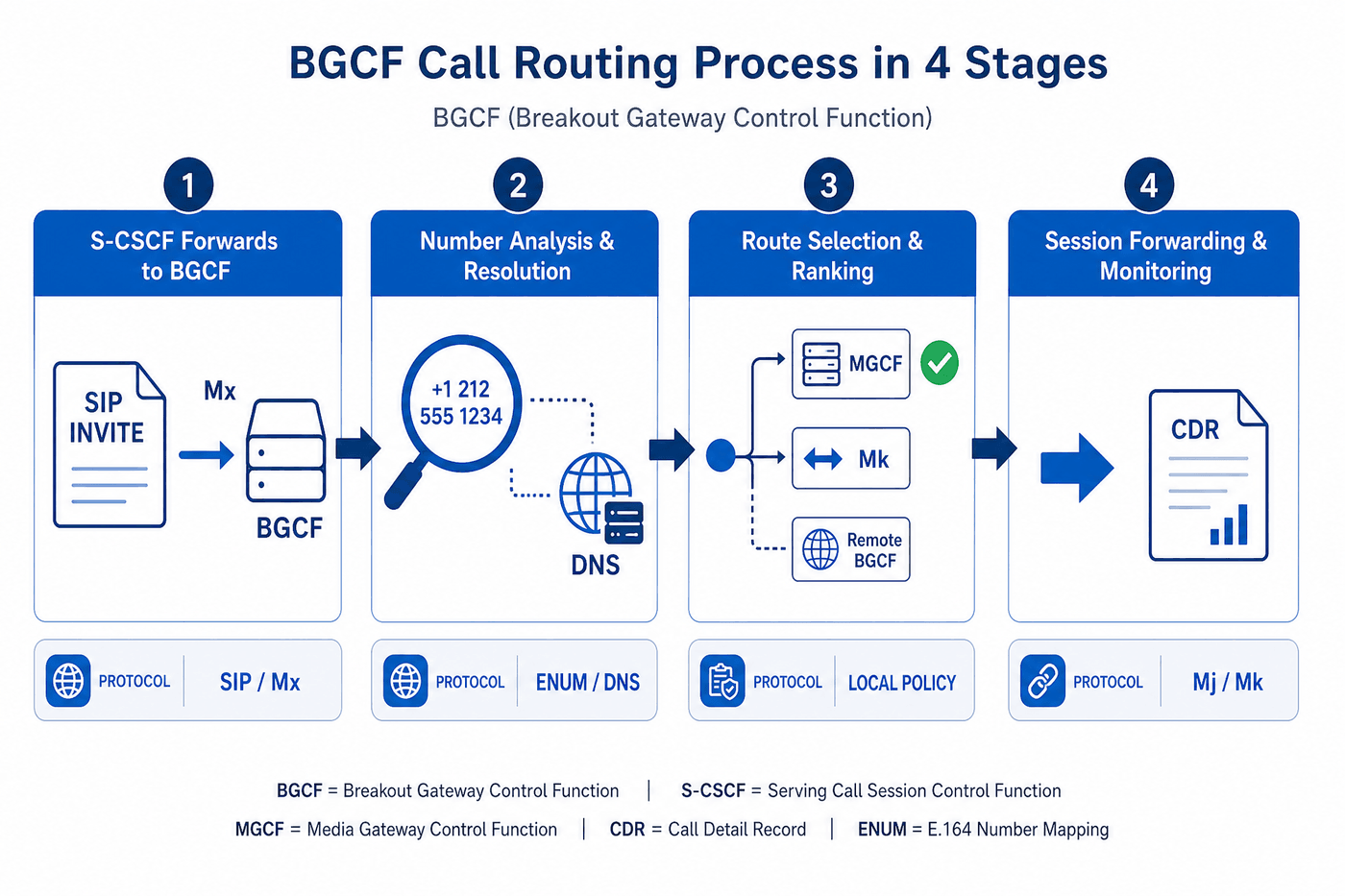
S-CSCF Forwards to BGCF
When the S-CSCF cannot resolve the called E.164 number within IMS (no ENUM match, no SIP URI), it forwards the SIP INVITE to BGCF via the Mx interface. BGCF receives the session with the original called party number intact.
Number Analysis & Resolution
BGCF performs multi-layer destination resolution: E.164 prefix analysis identifies the destination country/network, ENUM/DNS queries translate the number to routable URIs, and local policy evaluates available interconnect routes.
Route Selection & Ranking
Available routes are ranked by cost, quality, and policy compliance. BGCF selects the optimal MGCF within the same network — or, for inter-operator breakout, forwards the session to the remote network's BGCF via Mk.
Session Forwarding & Monitoring
BGCF forwards the SIP INVITE to the selected MGCF (via Mj) or remote BGCF (via Mk). Throughout the call, BGCF monitors session state and generates CDRs for interconnect billing — capturing every routing decision for audit and settlement.
Who Needs a Modern BGCF
Any operator bridging IP-based IMS voice with the global PSTN — from national carriers to international wholesalers
Mobile Network Operators
Route VoLTE calls to PSTN destinations through intelligent breakout. Eliminate legacy MSC-based routing, reduce interconnect costs, and scale routing capacity independently of media gateways.
Fixed-Line & Broadband Operators
Connect IMS-based fixed voice subscribers to the global PSTN. BGCF enables software-defined routing for millions of fixed-line subscribers without deploying hardware gateways at every exchange.
International Voice Carriers
Optimize international call routing with multi-layer resolution and least-cost path selection. BGCF-to-BGCF routing enables flexible interconnect topologies that adapt to changing market conditions in real time.
MVNOs & Light Operators
Launch PSTN-accessible voice services without owning any circuit-switched infrastructure. BGCF-as-a-Service routes your IMS calls to the PSTN through partner gateways — full PSTN reachability, zero hardware investment.
Frequently Asked Questions
How is BGCF different from an MGCF?
BGCF is a pure signaling (control plane) function that makes routing decisions — it selects which MGCF should handle the breakout. MGCF performs the actual protocol conversion (SIP ↔ ISUP/BICC) and controls the MGW for media transcoding. Separating them allows operators to scale routing intelligence and media handling independently, and source each from different vendors.
Can BGCF route calls between different IMS networks without going to PSTN?
Yes. When an IMS call targets another IMS network and the S-CSCF cannot resolve it directly, BGCF can forward the session to the destination network's I-CSCF (for IMS termination) or to that network's BGCF for further routing. This makes BGCF valuable for IPX and inter-IMS peering scenarios, not just IMS-to-PSTN breakout.
Does ZBensoft BGCF work with third-party MGCFs and S-CSCFs?
Absolutely. ZBensoft BGCF implements standard 3GPP Mx, Mj, and Mk interfaces using SIP, making it interoperable with any 3GPP-compliant S-CSCF and MGCF regardless of vendor. Operators can modernize the routing control layer without replacing existing media gateways — protecting existing investments while gaining software-defined routing agility.
Full-Stack Technology for Your Telecom Business
ZBensoft integrates charging, core network, and AI capabilities to help operators run efficiently and grow sustainably.
Request a Demo