Cloud-Native 5G Core Network
3GPP Release 17 compliant 5G Core network with Service-Based Architecture (SBA), supporting eMBB, URLLC, and mMTC use cases.
Why 5G Needs a New Core
4G EPC was built for smartphones. 5G needs a core built for everything — from autonomous cars to massive IoT
Service-Based Architecture
Every network function is an independent service — discoverable, scalable, and upgradeable without touching the rest of the core
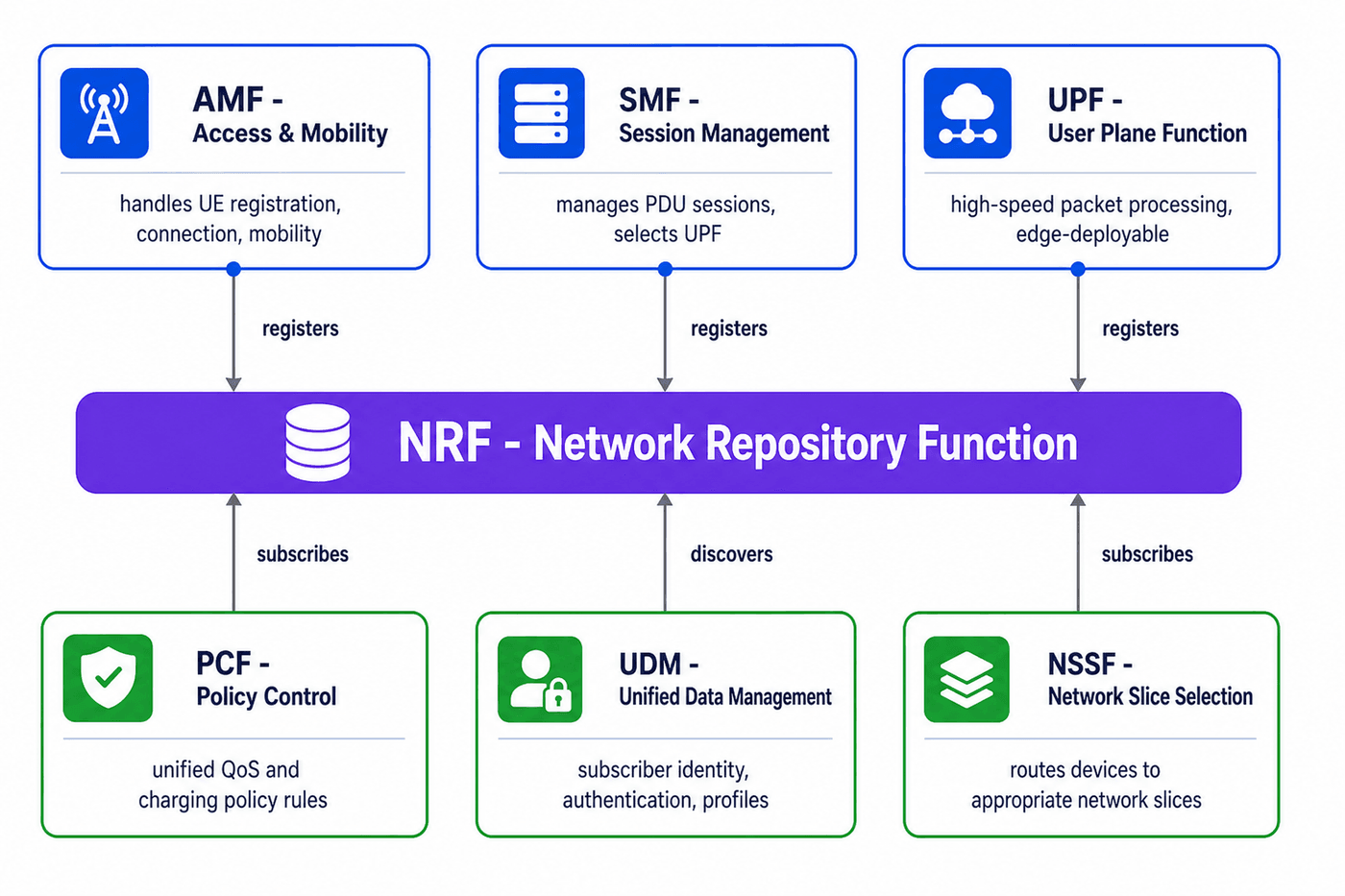
NRF at the center acts as the service directory. Every NF registers at startup and discovers peers dynamically. No hardcoded endpoints. No fixed connections.
Access & Mobility
Entry point from radio network. Handles registration, connection, and mobility.
Session Management
Manages data sessions. Selects and controls UPF for optimal user-plane routing.
User Plane
High-speed packet processing. Can be deployed at the edge for ultra-low latency.
Policy Control
Unified policy rules for QoS, charging, and per-slice enforcement.
Data Management
Unified subscriber data — identity, authentication, service profiles.
Slice Selection
Routes each device to the right network slice based on its service needs.
Network Slicing — One Network, Many Networks
Create dedicated virtual networks on shared infrastructure — each optimized for a specific business need
Consumer data, HD streaming, AR/VR experiences. High throughput, wide coverage.
Autonomous vehicles, industrial robots, remote surgery. Single-digit millisecond latency, 99.999% reliable.
Smart meters, sensors, asset trackers. Millions of devices per square kilometer, extreme power efficiency.
Cloud-Native by Design
5G Core runs like a modern internet service — containerized, orchestrated, and infrastructure-agnostic
Containerized NFs
Each network function runs as a Docker container. Independent lifecycle, independent scaling.
Kubernetes Orchestration
Automated deployment, rolling updates, self-healing. The same platform that runs Netflix runs your core network.
Infrastructure Agnostic
Deploy on bare metal, private cloud, or public cloud. No vendor lock-in at the hardware layer.
CI/CD DevOps
New features ship in days, not months. Canary deployments, A/B testing, gradual rollout — just like software.
What Operators Gain with 5G Core
The business case for building a standalone 5G core goes far beyond faster speeds
New Revenue Models
Sell network slices to enterprises. Expose network APIs to developers via NEF. Monetize ultra-low latency and massive IoT.
Lower Infrastructure Cost
Commodity x86 servers replace proprietary hardware. Independent NF scaling eliminates over-provisioning. Cloud-native = pay for what you use.
Faster Service Innovation
Decoupled NFs enable independent feature releases. New services launch in weeks instead of quarters. DevOps velocity comes to telecom.
NSA vs SA: Two Paths to 5G
Most operators start with Non-Standalone. The real transformation happens with Standalone.
Frequently Asked Questions
Can we deploy 5G Core alongside our existing 4G EPC?
Yes. The 5G Core is designed for smooth interworking with EPC. During transition, you can run both cores simultaneously — 5GC handles SA devices while EPC continues serving 4G and NSA devices. ZBensoft supports dual-core operations with unified management.
How does network slicing work in practice?
An operator defines slice templates — for example, an eMBB slice for consumers, a URLLC slice for a factory, and an mMTC slice for smart meters. Each slice gets dedicated or shared NF instances with specific SLAs. When a device connects, the NSSF routes it to the appropriate slice based on subscription data and requested service type.
Is 5G Core only for large national operators?
Not at all. ZBensoft 5G Core scales from compact deployments for private 5G networks in factories and ports, to carrier-grade distributed cores for nationwide operators. The cloud-native design means you can start with a minimal footprint and scale elastically as demand grows.
Full-Stack Technology for Your Telecom Business
ZBensoft integrates charging, core network, and AI capabilities to help operators run efficiently and grow sustainably.
Request a Demo